What is an Artificial Intelligence Robot and What are its Applications?
#Artificial Intelligence Robot is a combination of two important technology fields: #Artificial_Intelligence and #Robotics.
In simple terms, these robots are devices that, using artificial intelligence algorithms, are capable of performing tasks that normally require human intelligence.
These tasks can include learning, problem-solving, decision-making, pattern recognition, and even interacting with humans.
An artificial intelligence robot essentially tries to mimic human cognitive processes to deliver intelligent and efficient performance.
Artificial Intelligence is a broad field that includes various techniques and algorithms such as machine learning, neural networks, and natural language processing.
These algorithms allow robots to learn from data, identify patterns, and make informed decisions.
The applications of artificial intelligence robots are very broad and diverse.
In industry, these robots can be used for process automation, quality control, and increasing productivity.
In medicine, surgical robots perform complex operations with high precision, and nurse robots help care for patients.
In customer service, chatbot robots answer customer questions and solve their problems.
Artificial intelligence robots are even present in everyday life, including robotic vacuum cleaners that clean the house and voice assistants that respond to voice commands.
The development of artificial intelligence robots is rapidly advancing, and it is expected that they will play a more important role in our lives in the future.
Do you have an online store but your sales are not as expected? Rasaweb solves your problem forever with professional online store website design!
✅ Significant increase in conversion rate and sales
✅ Exceptional user experience for your customers
⚡ Click to receive free consultation with Rasaweb!
Main Components of a Smart Robot

An artificial intelligence robot consists of several main components, each of which plays an important role in its overall performance.
These components include:
- Sensors Sensors are tools that collect information about the surrounding environment.
This information can include temperature, light, sound, image, and so on.
Sensors allow the robot to be aware of its environment and respond to its changes. - Processor The processor (usually a computer) is the brain of the robot.
The processor’s job is to receive information from sensors, execute artificial intelligence algorithms, and generate control commands for actuators. - Actuators Actuators are tools that enable the robot to interact with its environment.
These actuators can include motors, arms, wheels, and so on. - Artificial Intelligence Software Artificial intelligence software is a set of algorithms and models that enable the robot to perform intelligent tasks.
This software includes machine learning algorithms, neural networks, and natural language processing. - Power Source The power source provides the energy needed for the robot to function.
This source can include batteries, AC power supply, or solar cells.
These components working together enable an artificial intelligence robot to perform its tasks effectively and efficiently.
Machine Learning and its Role in the Development of Smart Robots
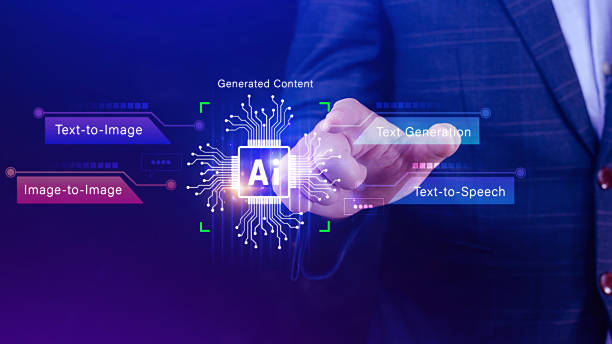
Machine Learning is one of the most important branches of artificial intelligence, playing a vital role in the development of smart robots.
Machine learning allows robots to learn from data and improve their performance without being explicitly programmed.
In other words, robots using machine learning algorithms can identify patterns in data, make predictions, and make better decisions.
There are different types of machine learning algorithms, each suitable for specific applications.
Some of the most important of these algorithms include:
- Supervised Learning In this type of learning, the robot is trained using labeled data.
For example, to train a face recognition robot, labeled images with people’s names are used. - Unsupervised Learning In this type of learning, the robot is trained using unlabeled data.
The goal is for the robot to discover hidden patterns and structures in the data.
For example, clustering algorithms are used to categorize customers of an online store. - Reinforcement Learning In this type of learning, the robot learns by trial and error.
The robot is placed in an environment and receives rewards or penalties for performing different actions.
The goal is for the robot to learn how to perform actions that receive the most reward.
Using machine learning in robots has many advantages.
It enables robots to perform more complex and diverse tasks, improve their performance over time, and automatically adapt to new conditions.
For example, an agricultural robot using machine learning can detect which part of the farm needs more irrigation and automatically adjust the irrigation.
By leveraging machine learning, artificial intelligence robots will be able to perform more complex tasks and adapt to dynamic environments.
Here is a sample table for comparing machine learning algorithms
| Algorithm | Type of Learning | Applications |
|---|---|---|
| Linear Regression | Supervised | Price Prediction, Sales Estimation |
| Decision Tree | Supervised | Classification, Risk Prediction |
| Support Vector Machine (SVM) | Supervised | Image Recognition, Text Recognition |
| K-means Clustering | Unsupervised | Customer Segmentation, Data Analysis |
| Deep Learning | Supervised/Unsupervised | Image Recognition, Natural Language Processing |

Click here to preview your posts with PRO themes ››
Artificial Intelligence Robots and their Applications in Industry

Artificial intelligence robots have revolutionized various industries and help improve company performance by automating tasks, increasing productivity, and reducing costs.
These robots have applications in various industrial fields, including manufacturing, logistics, agriculture, and energy.
In the manufacturing industry, artificial intelligence robots can be used for repetitive and dangerous tasks such as welding, painting, and assembling parts.
These robots work with high precision and without fatigue and can operate continuously and without interruption.
In the logistics industry, artificial intelligence robots can be used to optimize the supply chain, manage inventory, and deliver goods.
Using advanced algorithms, these robots can determine optimal routes for transporting goods, automatically manage warehouse inventory, and deliver orders quickly and accurately.
In the agricultural industry, artificial intelligence robots can be used to monitor crops, irrigate, fertilize, and harvest crops.
Using sensors and cameras, these robots can accurately assess the condition of crops and take necessary actions to improve their performance.
In the energy industry, artificial intelligence robots can be used to inspect pipelines, repair and maintain equipment, and optimize energy consumption.
These robots can operate in hazardous and inaccessible environments and collect valuable information to improve the performance of energy systems.
Overall, the use of artificial intelligence robots in industry can lead to increased productivity, reduced costs, improved quality of products and services, and increased safety.
With the advancement of technology, it is expected that the applications of these robots in industry will expand and play a more important role in the transformation of various industries.
Do you dream of a thriving online store but don’t know where to start?
Rasaweb is your comprehensive online store website design solution.
✅ Attractive and user-friendly design
✅ Increase sales and revenue⚡ Get free consultation
Artificial Intelligence Robots in the Medical and Healthcare Field
Artificial intelligence robots also have many applications in the medical and healthcare field and help doctors and specialists to have more accurate diagnoses, provide more effective treatments, and provide better care for patients.
One of the most important applications of these robots is in the diagnosis of diseases.
Artificial intelligence robots can use machine learning algorithms to analyze medical images such as MRI and CT scans and identify signs of diseases.
These robots can help doctors diagnose diseases in their early stages and start treatment in a timely manner.
Surgical robots perform complex operations with high precision and without tremors, helping to reduce surgery time, reduce bleeding, and improve surgical outcomes.
In the field of nursing, nurse robots can help patients with daily tasks, monitor their vital signs, and deliver medications on time.
These robots can help reduce the workload of nurses and allow them to dedicate more time to caring for patients.
Chatbot robots answer patients’ questions, provide medical information, and help them find the right doctor.
These robots can help improve access to medical services and reduce healthcare costs.
Overall, the use of artificial intelligence robots in the medical and healthcare field can lead to improved diagnostic accuracy, provision of more effective treatments, improved patient care, and reduced healthcare costs.
With the advancement of technology, it is expected that the applications of these robots in the medical and healthcare field will expand and play a more important role in improving the health of society.
Challenges and Limitations of Smart Robots
While artificial intelligence robots have many advantages, they also face challenges and limitations.
One of the most important challenges is the high cost of developing and implementing these robots.
Designing and building artificial intelligence robots requires expertise and advanced equipment and can be very costly.
Another challenge is the complexity of artificial intelligence algorithms.
Developing algorithms that can effectively perform complex tasks requires extensive research and development.
The ethical limitations of artificial intelligence robots are also an important challenge.
Using robots in important decisions such as hiring, granting loans, etc., can lead to discrimination and inequality.
Security concerns are also an important challenge.
Artificial intelligence robots may be vulnerable to cyberattacks and misuse.
For example, a hacker robot could be used to steal information or disrupt computer systems.
In addition, artificial intelligence robots still have limitations in understanding and interpreting natural language and interacting with humans.
Fully understanding natural language and answering complex questions requires further advancements in natural language processing.
Also, artificial intelligence robots still cannot fully understand and respond to human emotions.
This can create problems in interacting with humans.
Despite these challenges and limitations, it is expected that with the advancement of technology, many of these problems will be solved and artificial intelligence robots will play a more important role in our lives.
Artificial Intelligence
What Will the Future of Artificial Intelligence Robots Be?
The future of artificial intelligence robots is very bright and full of potential.
With the advancement of technology, it is expected that these robots will be able to perform more complex and diverse tasks and play a more important role in our lives.
One of the most important future trends is the development of autonomous robots.
These robots will be able to perform their tasks without the need for human intervention.
For example, self-driving robots can transport passengers without a driver, and automated agricultural robots can harvest crops without a farmer.
Click here to preview your posts with PRO themes ››
Another trend is the development of collaborative robots (Cobots).
These robots are designed to collaborate with humans and can work alongside humans in the workplace.
Collaborative robots can perform heavy and repetitive tasks and allow humans to focus on more creative and complex tasks.
In the future, artificial intelligence robots will be able to interact with humans more naturally and effectively.
These robots can understand and respond to human emotions, speak in natural language, and answer complex questions.
Finally, artificial intelligence robots in the future can help solve many global problems.
These robots can be used to combat climate change, treat diseases, provide food and water for all, and solve many other problems.
With the advancement of technology, artificial intelligence robots will be able to do things that we cannot even imagine today.
| Area | Predictions |
|---|---|
| Transportation | Self-driving cars, delivery drones |
| Healthcare | Robotic surgery, disease diagnosis with AI |
| Manufacturing | Full automation of production lines, collaborative robots |
| Services | Advanced chatbots, service robots |
| Education | Virtual teachers, personalized education |
How to Build an Artificial Intelligence Robot?
Building an artificial intelligence robot is a complex and multi-stage process that requires knowledge and skills in various fields, including robotics, artificial intelligence, programming, and electronics.
The main steps in building an artificial intelligence robot include:
- Define the Goal First of all, you need to define your goal in building the robot.
What is your robot going to do? What problems will it solve? Answering these questions will help you determine what type of robot you need and what features it should have. - Hardware Design In this step, you need to design the hardware of your robot.
This includes selecting the appropriate sensors, actuators, processor, and power source.
You should keep in mind that the selected hardware must be compatible with the purpose of the robot and your budget constraints. - Programming In this step, you need to program the software of your robot.
This includes writing code to control the hardware, process data, and execute artificial intelligence algorithms.
You should use a suitable programming language such as Python, C++, or Java. - Training In this step, you need to train your artificial intelligence algorithms.
This includes collecting training data, selecting appropriate algorithms, and adjusting algorithm parameters.
You should keep in mind that the quality of the training data has a significant impact on the performance of your robot. - Testing and Evaluation In this step, you need to test and evaluate your robot.
This includes checking the robot’s performance in different conditions and identifying and fixing problems.
You should keep in mind that testing and evaluation is an iterative process and you may need to do it several times.
Building an artificial intelligence robot is a challenging but very exciting project.
With effort and perseverance, you can build a smart robot that helps solve problems and improve our lives.
You still don’t have a company website and are missing out on online opportunities? With professional company website design by Rasaweb,
✅ Double the credibility of your business
✅ Attract new customers
⚡ Free consultation for your company website!
Skills Required to Work with Artificial Intelligence Robots

Working with artificial intelligence robots requires a combination of technical and soft skills.
Some of the most important skills required include:
- Knowledge of Robotics To work with artificial intelligence robots, you need to have sufficient knowledge of robotics.
This includes understanding the principles of mechanics, electronics, and control. - Knowledge of Artificial Intelligence To work with artificial intelligence algorithms, you need to have sufficient knowledge of artificial intelligence.
This includes understanding the principles of machine learning, neural networks, and natural language processing. - Programming Skills To program artificial intelligence robots, you need to have sufficient programming skills.
You should use a suitable programming language such as Python, C++, or Java. - Problem-Solving Skills To solve problems related to artificial intelligence robots, you need to have sufficient problem-solving skills.
This includes the ability to identify problems, analyze them, and find appropriate solutions. - Teamwork Skills To work on artificial intelligence robot projects, you need to have sufficient teamwork skills.
This includes the ability to collaborate with others, communicate effectively, and resolve disputes.
In addition to these skills, having creativity, curiosity, and a passion for learning is also very important for working with artificial intelligence robots.
By acquiring these skills, you can become a successful expert in the field of artificial intelligence robots and help develop and advance this technology. Artificial intelligence robots
Click here to preview your posts with PRO themes ››
Important Points to Consider When Buying an Artificial Intelligence Robot

Buying an artificial intelligence robot can be an important investment, so you should pay attention to important points before buying to make the right choice.
- Define your Goal Before buying, you need to define your goal in buying the robot.
What do you want the robot to do? What problems do you want to solve? Answering these questions will help you determine what type of robot you need and what features it should have. - Determine your Budget Artificial intelligence robots are offered at different prices.
Before buying, you need to determine your budget and choose a robot that is compatible with your budget. - Do your Research Before buying, you should research different robots and read user reviews.
This will help you become aware of the advantages and disadvantages of each robot and make a better choice. - Pay Attention to Warranty and After-Sales Service Before buying, you should pay attention to the warranty and after-sales service of the robot.
Make sure that the robot has a valid warranty and that you can use after-sales service if a problem occurs. - Buy from Reputable Stores To buy an artificial intelligence robot, go to reputable stores.
This assures you that you are buying the original robot and benefiting from appropriate after-sales service.
By paying attention to these points, you can buy a suitable artificial intelligence robot and benefit from its advantages.
Frequently Asked Questions
| Question | Answer |
|---|---|
| What is an Artificial Intelligence Robot? | It is a robot that uses artificial intelligence capabilities to understand the environment, reason, learn, and make decisions to perform complex tasks independently. |
| What is the main difference between a regular robot and an artificial intelligence robot? | Artificial intelligence robots can learn and adapt to their environment, while regular robots usually operate based on fixed and pre-determined plans. |
| In what areas are artificial intelligence robots used? | In areas such as industry (production lines), medicine (robotic surgery), services (customer support, smart vacuum cleaners), exploration (space and underwater), and entertainment. |
| How do artificial intelligence robots learn? | They acquire new skills through machine learning (Machine Learning) and deep learning (Deep Learning) algorithms, by analyzing big data and identifying patterns. |
| Can artificial intelligence robots have emotions? | Currently, no. They can identify or simulate emotions, but they do not have the real experience of emotions like humans. |
| What are the most important advantages of using artificial intelligence robots? | Increased productivity, reduced human error, performing dangerous or repetitive tasks, and providing innovative and efficient services. |
| What challenges exist in the development of artificial intelligence robots? | The need for abundant and high-quality data, the complexity of algorithms, ethical issues, cybersecurity, and the high cost of research and development. |
| Are artificial intelligence robots dangerous to humans? | By following safe design principles and ethical regulations, no. Concerns are more related to social and economic impacts such as changes in the labor market. |
| What is an example of an artificial intelligence robot in everyday life? | Smart vacuum cleaners (like Roomba) that automatically map and clean the house, or smart voice assistants (like Siri and Alexa). |
| How is the future of artificial intelligence robots predicted? | They are expected to become smarter, more autonomous, and able to interact more complexly with humans and play a more prominent role in industry, medicine, transportation, and everyday life. |
and other services of Rasaweb Advertising Agency in the field of advertising
Intelligent Marketplace: Transform sales growth with the help of customizing the user experience.
Intelligent Link Building: A creative platform to improve customer behavior analysis with accurate audience targeting.
Intelligent Social Media: A professional solution for customer behavior analysis with a focus on intelligent data analysis.
Intelligent Custom Software: An innovative service to increase user engagement by customizing the user experience.
Intelligent Link Building: A creative platform to improve digital branding with Google Ads management.
And more than hundreds of other services in the field of internet advertising, advertising consulting, and organizational solutions
Internet Advertising | Advertising Strategy | Advertorial Report
Sources
What is Artificial Intelligence? Everything About Artificial Intelligence
,Artificial Intelligence Chat Robot (Bot)
,What is Artificial Intelligence? | Applications, Types, and Future of AI | Aryanic
,Introductory Training on Artificial Intelligence – Artificial Intelligence
? Are you ready to transform your business in the digital world? Afarin Rasaweb Digital Marketing Agency, with expertise in various fields including Professional Website Design, SEO, and Social Media Management, paves the way for your growth and success.
📍 Tehran, Mirdamad Street, next to the Central Bank, South Kazerun Alley, Ramin Alley No. 6