
What is On-Page SEO and Why Does It Matter?

#OnPageSEO is a set of techniques and actions performed to optimize web pages in order to improve their ranking in search engine results, such as Google.
This type of SEO focuses on elements of the website that you can directly control, such as content, structure, and HTML code.
The importance of on-page SEO is that by improving these elements, the chance of your site being seen in search results increases, resulting in more organic traffic being driven to your site.
Organic traffic refers to visitors who enter your site through searches on search engines without you paying for advertising.
On-page SEO helps you show search engines what your site is about and how much high-quality, relevant content it provides.
With proper optimization, search engines can easily understand your site’s content and display it to users who are looking for relevant information.
This not only increases your site’s traffic but also helps improve conversion rates (turning visitors into customers), as users who come to your site through search are usually looking for answers to their questions or solutions to their problems, and are more likely to buy or use your services if you provide useful and relevant content.
For a better understanding, see this link.
Is your online sales not as expected? With Rasaweb, solve the problem of low sales and poor user experience forever!
✅ Increase visitor-to-customer conversion rate
✅ Create an enjoyable user experience and increase customer trust
⚡ Get free consultation now!
Keyword Research: The Cornerstone of On-Page SEO

Keyword research is the most important step in the on-page SEO process.
Keywords are the phrases that users enter into search engines to find the information they need.
By identifying keywords related to your business and website content, you can create content that is specifically optimized for these words and ranks higher in search results.
There are various tools for keyword research, including Google Keyword Planner, Ahrefs, and SEMrush.
These tools help you find the search volume of different keywords, the level of competition for them, and related keywords.
After identifying the appropriate keywords, you need to use them strategically in your site’s content.
This includes using keywords in the page title, meta descriptions, headings (H1, H2, H3, etc.), the main text of the page, and the alternative text of images (Alt text).
However, it is important to avoid overuse of keywords (Keyword Stuffing), as this can lead to your site being penalized by search engines.
Your content should be natural and fluent, and keywords should be included organically.
Remember that your main goal is to provide high-quality and relevant content to users, not just optimize for search engines.
The importance of on-page SEO in search results is undeniable.
Optimizing the Title Tag and Meta Description
The Title Tag and Meta Description are two important elements in on-page SEO that are displayed to users in search results.
The Title Tag is the main title of your page and should be short, catchy, and contain the page’s main keyword.
The Meta Description is a short summary of the page’s content and should be written in a way that encourages users to click on your link.
The meta description should include the main keyword as well as a call to action.
For example, if your page is about “The Best Italian Restaurants in Tehran,” the title tag could be “The Best Italian Restaurants in Tehran | Introduction and Review” and the meta description could be “Find the best Italian restaurants in Tehran with customer reviews and their menus. Online booking and special discounts!”.
The Title Tag and Meta Description should be unique for each page of your site and should accurately match the content of the page.
Also, the length of the title tag should be less than 60 characters and the length of the meta description should be less than 160 characters to be fully displayed in the search results.
These are all effective in on-page SEO.

Click here to preview your posts with PRO themes ››
Here is an example of Title Tag and Meta Description optimization:
| Element | Example |
|---|---|
| Title Tag | Buy Men’s Shoes Online | Best Prices at Digikala |
| Meta Description | The largest variety of men’s shoes at the best prices. Free shipping and payment on delivery. Buy now! |
Optimizing Heading Tags

Headings (H1 to H6) are used to structure page content and indicate the relative importance of different sections to search engines.
The H1 tag is the most important title on the page and should only be used once per page.
H1 should include the page’s main keyword and clearly state the main topic of the page.
H2 to H6 tags are used for subheadings and content subsets and should be organized hierarchically.
For example, if your page is about “SEO Training”, H1 could be “SEO Training from Zero to One Hundred” and H2 could be “Keyword Research”, “Content Optimization”, and “Link Building”.
Using headings correctly helps search engines better understand the structure and topic of your content, and also helps users easily navigate your page and find the information they need.
Make sure your headings are readable and engaging and naturally incorporate keywords.
Take on-page SEO seriously.
Is your online sales not as expected? With Rasaweb, solve the problem of low sales and poor user experience forever!
✅ Increase visitor-to-customer conversion rate
✅ Create an enjoyable user experience and increase customer trust
⚡ Get free consultation now!
Content Optimization; The King of On-Page SEO

Content is the king of on-page SEO.
High-quality, relevant, and valuable content for users is the most important factor in ranking web pages in search engines.
Your content should answer users’ questions, solve their problems, and provide them with useful and valuable information.
The content should be unique and avoid copying other people’s content.
To optimize content, you should naturally include your target keywords in the text, but avoid overuse of keywords.
Structure your content in a readable and organized manner, using headings, paragraphs, lists, and images.
Update your content regularly and add new and relevant information to it.
Also, make sure your content is optimized for mobile devices (Mobile-Friendly) and loads quickly.
Read more about quality content here.
Improving on-page SEO also helps improve user experience.
Image Optimization; Beyond Text
Images can play an important role in attracting users and improving your site’s on-page SEO.
High-quality and relevant images can make your content more attractive and understandable and help users better understand the information.
To optimize images, you should use descriptive filenames that contain keywords.
For example, instead of using the filename “IMG_1234.jpg”, use the filename “men-leather-shoes-black.jpg”.
Also, you should use alternative text (Alt text) for images.
Alt text is a short description of the image that is displayed to users if the image is not displayed and helps search engines understand the content of the image.
The alt text should be short, descriptive, and contain relevant keywords.
In addition, you should reduce the file size of images to increase the loading speed of your site pages.
Use online image compression tools or image editing software such as Photoshop to reduce the file size of images.
Pay attention to your images in on-page SEO.
On-page SEO has a significant impact on site ranking.
URL Optimization; SEO-Friendly Addresses

Web page addresses (URLs) should be short, descriptive, and contain keywords.
SEO-friendly addresses help search engines better understand the topic of the page and also help users easily remember and share the page.
Avoid using special characters, numbers, and uppercase letters in addresses.
Click here to preview your posts with PRO themes ››
For example, instead of using the address “www.example.com/page?id=1234”, use the address “www.example.com/basic-seo-training”.
Try to use the page’s main keywords in the address, but avoid overuse of keywords.
Addresses should be readable and understandable and clearly indicate the topic of the page.
Also, avoid using long and complex addresses, as these addresses are difficult for users and search engines.
Start on-page SEO by optimizing addresses.
Here is an example of optimized and unoptimized URLs:
| Status | Example |
|---|---|
| Optimized | https://example.com/seo-guide |
| Unoptimized | https://example.com/page?id=123 |
Internal Linking; Creating a Network of Communication

Internal linking means creating links between different pages of your site.
Internal linking helps search engines better understand your site’s structure and also helps users easily navigate your site and find the information they need.
Internal linking should be done strategically and the links should be relevant to the content of the pages.
For example, if you are talking about “Technical SEO” on one page, you can link to a page that talks about “Content SEO”.
Internal linking not only helps improve your site’s SEO but also helps improve user experience, as users can easily access related information.
Use descriptive anchor text that clearly states the topic of the destination page.
On-page SEO and internal linking are necessary for each other.
Are you bothered by losing customers who have visited your site to buy?
Rasaweb is your specialized solution for having a successful online store.
✅ Significant increase in your online sales
✅ Creating trust and professional branding with customers⚡ Get free consultation from Rasaweb experts!
Site Loading Speed; Optimized User Experience
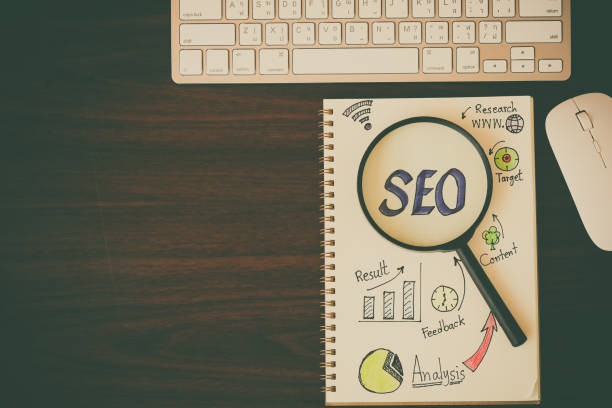
Site loading speed is one of the important factors in on-page SEO.
Users get tired of websites that load slowly and are more likely to leave the site.
Search engines also pay attention to site loading speed, and websites that load faster rank better in search results.
To improve your site’s loading speed, you can use various methods, including: optimizing images, using a fast content management system (CMS), using a quality hosting, using CDN (Content Delivery Network), and enabling Gzip compression.
You can also use site speed testing tools such as Google PageSpeed Insights and GTmetrix to identify problems with your site’s loading speed and implement their suggested solutions.
Loading speed plays an important role in on-page SEO.
Mobile Optimization; Comprehensive Access

Today, more than half of internet traffic comes from mobile devices.
Therefore, optimizing the website for mobile (Mobile-Friendly) is very important.
Your website should display correctly on mobile devices, be readable, and be easy to use.
To optimize a website for mobile, you can use a responsive design that automatically adjusts the size and structure of your website to the screen size of the device.
You should also use readable fonts and large buttons so that users can easily interact with your website.
Search engines also pay attention to websites that are optimized for mobile and rank better in search results.
On-page SEO along with mobile optimization increases site ranking.
Do not forget that **on-page SEO** is a continuous process and needs follow-up and updating.
By implementing these techniques and constantly updating your website, you can improve your website’s ranking in search results and attract more organic traffic.
**On-page SEO** is a long-term investment that can have a significant return on investment.
Consider **on-page SEO** as an essential part of your online marketing strategy.
By focusing on **on-page SEO**, you can ensure that your website is effectively optimized for search engines and is constantly improving.
**On-page SEO** helps you turn your website into a valuable resource for users and achieve your business goals.
Do not underestimate the importance of **on-page SEO**.
**On-page SEO** can be the difference between being seen and being ignored.
**On-page SEO** along with a good strategy can lead you to success.
So practice **on-page SEO** and stay up to date.
Click here to preview your posts with PRO themes ››
Frequently Asked Questions
| Question | Answer |
|---|---|
| What is On-page SEO? | On-page SEO refers to a set of actions performed inside your website to improve its ranking in search engine results. This includes optimizing content, site structure, and HTML code. |
| Why is on-page SEO important? | On-page SEO helps search engines understand the content of your page and determine whether your content is relevant to searchers. This is the foundation of any successful SEO strategy. |
| What are the key elements of on-page SEO? | Title Tag, Meta Description, use of keywords, image optimization, heading structure (H1, H2, …), internal linking, and content quality are key elements. |
| How to optimize the Title Tag? | The title tag should include the main keyword, be attractive and enticing to click, and its length should be between 50 and 60 characters (or appropriate pixels) to be fully displayed in search results. |
| What role does Meta Description play in on-page SEO? | The meta description is a summary of the page content that is displayed below the title in the search results. Although it does not directly affect ranking, it helps SEO by increasing the click-through rate (CTR). |
| What is the importance of using Heading structure (H1, H2, H3) in on-page SEO? | Headings structure the page content and make it easier to read. H1 is usually the main title of the page and should include the keyword. H2 and H3 are used to organize sub-sections and help search engines understand the content hierarchy. |
| How to use keywords effectively in content? | Keywords should be used naturally and logically throughout the content, including the introduction, body, and conclusion. Avoid keyword stuffing. |
| What steps does image optimization for on-page SEO involve? | Includes compressing images to reduce the volume, using descriptive filenames, adding appropriate alternative text (Alt Text), and optimizing the image title and description. Alt Text is critical for accessibility and helping search engines understand the image content. |
| What is Internal Linking and what are its benefits? | Internal linking means creating a link from one page on your website to another page on the same website. This helps users easily navigate your site, distributes page authority throughout the site, and helps search engines better understand your site structure. |
| What is the importance of content quality in on-page SEO? | High-quality, accurate, comprehensive, and valuable content for users is the cornerstone of on-page SEO. Search engines prefer content that meets the needs of users. Quality content leads to longer user dwell time and reduced bounce rate, which are positive SEO signals. |
And other services of Rasa Web advertising agency in the field of advertising
Smart Custom Software: A combination of creativity and technology to increase sales by intelligently analyzing data.
Smart UI/UX: A combination of creativity and technology to analyze customer behavior through precise audience targeting.
Smart Conversion Rate Optimization: An exclusive service to grow SEO ranking improvement based on the use of real data.
Smart Customer Journey Map: An exclusive service for growing sales increases based on precise audience targeting.
Smart Data Analysis: A fast and efficient solution to improve SEO ranking with a focus on intelligent data analysis.
And more than hundreds of other services in the field of internet advertising, advertising consulting and organizational solutions
Internet Advertising | Advertising Strategy | Advertorial
Resources
What is On-Page SEO?
,On-Page SEO Training
,Comprehensive On-Page SEO Guide (Moz)
,On-Page SEO: The Complete Guide
? Are you ready to transform your business in the digital world? Rasaweb Afarin Digital Marketing Agency, specializing in modern UI website design, SEO, and content marketing strategies, paves the way for your online success.
📍 Tehran, Mirdamad Street, next to the Central Bank, Southern Kazerun Alley, Ramin Alley, No. 6