
What is On-Page SEO and Why Does it Matter?

On-Page SEO refers to the set of actions you take within your website to improve your site’s ranking in Google search results and other search engines.
These actions include optimizing content, site structure, HTML tags, and other internal elements of the site.
The importance of On-Page SEO lies in the fact that it helps search engines better understand your site’s content and recognize its relevance to users’ searches.
A site optimized for #on_page_seo is more likely to rank high in search results and attract more organic traffic.
In fact, On-Page SEO is a fundamental foundation for other SEO strategies, such as Off-Page SEO and Technical SEO.
The main goal of On-Page SEO is to provide an excellent user experience and valuable content to site visitors.
When users can easily find the information they need and enjoy your site’s content, they are more likely to stay on your site, view more pages, and ultimately become your customers.
So, On-Page SEO is not just for search engines; it is also very important for users.
On-Page SEO is a long-term investment that shows its positive results over time.
Did you know that 94% of users’ first impression of a business is related to its website design? Turn that first impression into an opportunity for growth with professional corporate website design by **Rasaweb**.
✅ Attract more customers and increase sales
✅ Create credibility and trust in the eyes of the audience⚡ Get free website design consultation!
Keyword Research; The First Step in On-Page SEO

Keyword research is one of the most important steps in On-Page SEO.
In this step, you need to find the words that users use to search for products, services, or information related to your business.
These keywords must be relevant to your site’s content and have a decent search volume.
To conduct keyword research, you can use various tools such as Google Keyword Planner, Ahrefs, and SEMrush.
These tools help you find keywords related to your business, check their search volume, and assess the level of competition for each keyword.
After finding suitable keywords, you should use them naturally and optimally in your site’s content.
Using keywords in page titles, meta descriptions, header tags (H1-H6), and the main text of the content helps search engines understand the main topic of your pages and display them in search results for relevant keywords.
However, you should avoid using keywords excessively, as this may cause your site to be penalized by Google.
The main goal should be to create valuable and engaging content for users that naturally uses relevant keywords.
On-Page SEO should be done intelligently.
Content Optimization; The Heart of On-Page SEO

Content is king! This phrase clearly shows the importance of content in SEO.
Producing high-quality, engaging, and valuable content is one of the most important factors for success in On-Page SEO.
Your content should answer users’ questions and needs, provide accurate and complete information, and be written in a way that is appealing to readers.
To optimize content, you should use relevant keywords naturally and optimally, organize your content structure well (using header tags, paragraphs, and lists), use relevant images and videos, and update your content regularly.
Also, you should make sure that your content is original and avoid copying other people’s content.
High-quality content not only helps improve your site’s ranking in search results but also attracts more users to your site, increases the time they spend on your site, and increases the likelihood that they will become your customers.
On-Page SEO with quality content can help your business.
| Element | Description | Importance for SEO |
|---|---|---|
| Page Title (Title Tag) | The title of the page that is displayed in search results. | Very important; should include the main keyword. |
| Meta Description | A short description of the page’s content that is displayed in search results. | Important; should be engaging and relevant to the content to encourage users to click. |
| Header Tags (H1-H6) | Tags used to structure content. | Important; H1 should be the main title of the page and include the main keyword. |
| Main Content Text | The main text of the page, which includes information, descriptions, and content related to the topic. | Very important; should be high-quality, valuable, and optimized for keywords. |

Image Optimization; An Opportunity for On-Page SEO

Images play an important role in the attractiveness and understanding of your site’s content.
By optimizing images, you can help improve your site’s On-Page SEO.
To optimize images, you should use appropriate file names (including relevant keywords), use alt tags (alternative text) for images (which helps search engines understand the content of the image), and reduce the size of the images (to increase the loading speed of your site’s pages).
Using high-quality and relevant images attracts more users to your site and increases the time they spend on your site.
By optimizing images, you can attract more organic traffic to your site through image search.
Image Optimization is an important part of On-Page SEO that should not be ignored.
Improve your site’s ranking with correct On-Page SEO for images.
You can also use Schema Markup for your images to provide more information about your images to search engines.
This can cause your images to be displayed in rich snippets in search results and attract more attention.
On-Page SEO for images also helps improve user experience.
Doesn’t your current corporate website reflect your brand’s credibility and power as it should? Rasaweb solves this challenge for you with professional corporate website design.
✅ Increase the credibility and trust of visitors
✅ Attract more targeted customers
⚡ Click to receive free consultation!
URL Structure; Guiding Search Engines
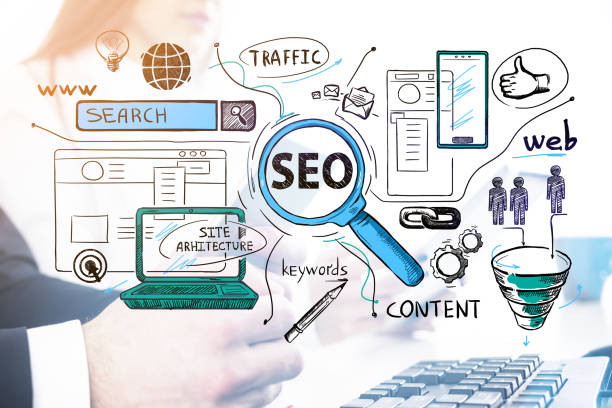
The URL structure of your site’s pages plays an important role in On-Page SEO.
URLs should be short, descriptive, and include relevant keywords.
Long and complex URLs are not attractive to search engines and users.
For example, instead of using a URL like `www.example.com/page?id=123`, use a URL like `www.example.com/seo-internal`.
This URL is more understandable for search engines and more attractive to users.
Also, you should avoid using special characters and spaces in URLs.
A proper URL structure helps search engines better understand your site’s structure and index your pages correctly.
Also, descriptive URLs make it easier for users to guess the topic of your pages and increase the likelihood that they will click on your links.
Improve your site’s On-Page SEO with a proper URL structure.
Internal Linking; Building a Strong Network
Internal linking refers to the process of creating links between different pages of your site.
This helps search engines better understand your site’s structure, identify the more important pages of your site, and distribute authority between the different pages of your site.
Internal linking also helps users easily navigate your site, find related pages, and learn more about topics of interest to them.
For internal linking, you should use relevant and descriptive anchor texts and link to pages that are truly relevant to the content of the current page.
Proper internal linking increases the time users spend on your site, the number of pages they view, and the likelihood that they will become your customers.
On-Page SEO with internal linking can have a positive impact on your site’s ranking.

Click here to preview your posts with PRO themes ››
Site Loading Speed; Better User Experience

Site loading speed is one of the most important ranking factors in Google.
Users expect your site’s pages to load in less than a few seconds.
If your site is slow, users will leave your site and go to competing sites.
To increase site loading speed, you can use various methods such as optimizing images, using a CDN (Content Delivery Network), enabling caching, and reducing the size of HTML, CSS, and JavaScript code.
Google’s PageSpeed Insights tool helps you check your site’s loading speed and identify related issues.
High loading speed not only improves your site’s ranking in search results but also attracts more users to your site, increases the time they spend on your site, and provides a better user experience.
On-Page SEO helps improve user experience by increasing site loading speed.
| Factor | Description | Test Tool |
|---|---|---|
| Server Speed | The response speed of the web hosting server. | WebPageTest |
| Page Size | The total size of resources loaded by the page (HTML, CSS, JavaScript, Images). | Google PageSpeed Insights |
| HTTP Requests | The number of HTTP requests to load page resources. | GTmetrix |
| Compression | Use Gzip compression to reduce file size. | Check Gzip Compression |
| Browser Cache | Using browser cache to store static resources. | Google PageSpeed Insights |
Site Responsiveness; Correct Display on All Devices
Today, most internet users access websites through their mobile phones.
Therefore, your site must be responsive; that is, it must be designed to display correctly on all devices (mobile phone, tablet, computer).
A responsive site provides a better user experience for users, reduces the likelihood that users will leave your site, and helps improve your site’s ranking in Google search results.
Google gives a better ranking to sites that are responsive.
To ensure that your site is responsive, you can use Google’s Mobile-Friendly Test tool.
On-Page SEO improves user experience by making the site responsive.
Are your online sales not as expected? With Rasaweb, solve the problem of low sales and poor user experience forever!
✅ Increase visitor-to-customer conversion rate
✅ Create an enjoyable user experience and increase customer trust
⚡ Act now to receive free consultation!
Using Schema Markup; Better Understanding of Content
Schema Markup is code that helps search engines better understand the content of your site’s pages.
By using Schema Markup, you can provide more information about products, services, articles, events, and other types of content to search engines.
This causes your site to be displayed in rich snippets in search results and attract more attention.
Rich snippets provide more information about your site to users and increase the likelihood that users will click on your link.
Schema Markup is a powerful tool for improving On-Page SEO that can help increase your site’s organic traffic.
On-Page SEO and Schema Markup together can increase your site’s ranking.
Improve your site’s On-Page SEO by using Schema Markup.
On-Page SEO requires updates.
Analysis and Continuous Improvement; The Key to Success in On-Page SEO
On-Page SEO is an ongoing process and requires analysis and continuous improvement.
You should regularly review your site’s performance, identify its strengths and weaknesses, and work to improve it.
To analyze your site’s performance, you can use tools such as Google Analytics and Google Search Console.
These tools help you check your site’s traffic, identify the keywords through which users reach your site, check the bounce rate of your pages, and identify problems related to indexing your site.
Using this information, you can improve your On-Page SEO strategy, produce higher quality content, increase your site’s loading speed, and provide a better user experience for your users.
On-Page SEO with constant analysis and review can help improve your site’s ranking.
On-Page SEO requires that you always keep your information up to date.
Note that On-Page SEO is a dynamic science and Google’s algorithms are constantly changing, and you must adapt to the changes.
Click here to preview your posts with PRO themes ››
Frequently Asked Questions
| Question | Answer |
|---|---|
| What is On-page SEO? | On-page SEO refers to the set of actions taken within a website and on the content of pages to achieve a better ranking in search results. |
| Why is on-page SEO important for a website? | On-page SEO helps search engines better understand your page content and assess its importance. It also provides a better user experience for visitors. |
| What are the most important on-page SEO factors? | The most important factors include keyword optimization, content quality, Title Tag, Meta Description, URL structure, Heading tags (H1-H6), internal linking, and image optimization. |
| What role does the Title Tag play in on-page SEO? | The title tag is one of the most important on-page SEO factors, displaying your page’s title in search results and browser tabs. It should include the main keyword and be engaging. |
| What is the importance of the Meta Description in on-page SEO? | The Meta Description provides a summary of the page’s content, and although it does not directly affect rankings, it can increase click-through rate (CTR) by encouraging users to click. |
| How are keywords used in on-page SEO? | Keywords are terms that users use to search for information in search engines. The appropriate and natural use of them in the content helps search engines to recognize the topic of the page. |
| What is internal linking and what are its benefits in on-page SEO? | Internal linking means creating links between different pages of a website. This helps distribute the authority of pages, helps search engine robots crawl, and improves user experience. |
| How does image optimization affect on-page SEO? | Image optimization includes compressing the size, using appropriate Alt tags, and properly naming files. This improves page loading speed and helps search engines understand the content of the image. |
| What does high-quality content mean in on-page SEO? | High-quality content means content that is comprehensive, accurate, unique, up-to-date, and user-friendly, and that meets the needs of users. |
| What role does the URL structure play in on-page SEO? | Readable, short URLs that include the main keyword help search engines and users better understand the content of the page and improve user experience. |
And other services of Rasa Web Advertising Agency in the field of advertising
Intelligent data analysis: An effective tool for attracting customers through marketing automation.
Intelligent digital branding: An effective tool for digital branding by designing an attractive user interface.
Intelligent reporting: A creative platform for improving website visits with marketing automation.
Intelligent UI/UX: A novel service for increasing click-through rates by optimizing key pages.
Intelligent advertising campaign: A combination of creativity and technology to attract customers through marketing automation.
And more than hundreds of other services in the field of internet advertising, advertising consulting and organizational solutions
Internet Advertising | Advertising Strategy | Advertorial
Resources
What is On-Page SEO? Comprehensive On-Page SEO Training in 2024
,On-Page SEO Training; 2024 Update + Checklist
,What is On-Page SEO and What is its Importance for a Website?
,What is On-Page SEO? + 20 On-Page SEO Optimization Techniques
? To elevate your business in the digital world, Rasaweb Afrin Digital Marketing Agency, by providing services such as user-friendly website design, professional SEO and social media management, paves the way for your success.
📍 Tehran, Mirdamad Street, next to the Central Bank, South Kazerun Alley, Ramin Alley No. 6