
What is On-Page SEO and Why Does it Matter?

What is On-Page SEO and Why Does it Matter?
On-Page SEO refers to a set of actions performed within your website to improve the site’s ranking in search engine results like Google.
These actions include optimizing content, title tags, meta descriptions, URL structure, and more.
The importance of On-Page SEO stems from the fact that search engines use these factors to understand the topic and relevance of the site’s content to the user’s search query.
Optimizing SEO internally helps search engines better identify your site and, as a result, increase its ranking.
With strong On-Page SEO, the chances of your website being seen in search results increase, leading to increased traffic, audience engagement, and ultimately increased sales.
On-Page SEO is one of the main pillars of #SEO, and ignoring it can nullify other SEO efforts.
On-Page SEO and Off-Page SEO are two inseparable parts of website optimization.
Are you tired of your online store not generating as much revenue as it potentially could? Rasaweb, a specialist in professional online store design, solves this problem for good!
✅ Increased sales and revenue rates
✅ High loading speed and exceptional user experience
⚡ Get free consulting for online store design
Keyword Research – The Cornerstone of On-Page SEO
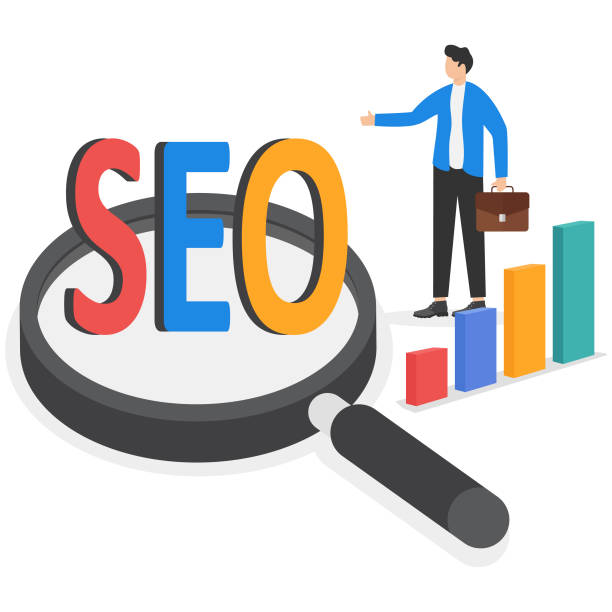
Keyword Research – The Cornerstone of On-Page SEO
Keyword research is one of the most important steps in On-Page SEO.
Before anything else, you need to know what terms your audience is using to search for your products or services.
To do this, you can use various tools such as Ahrefs Keywords Explorer, KeywordTool.io, Ubersuggest, and Google Keyword Planner.
When choosing keywords, pay attention to search volume, competition level, and the keyword’s relevance to your site’s content.
Divide the keywords into different categories and create separate pages on your site for each category.
For example, if you have an online clothing store, you can create categories like “women’s dresses,” “men’s pants,” and “sports shoes.”
Using appropriate keywords in content, title tags, meta descriptions, and URL addresses helps search engines better understand the topic of your page and improve its ranking.
Don’t forget that Long-Tail Keywords are also very important and can attract targeted traffic to your site.

Click here to preview your posts with PRO themes ››
Optimizing Page Title (Title Tag) and Meta Description
Optimizing Page Title (Title Tag) and Meta Description
The Title Tag and Meta Description are two important elements in On-Page SEO that are displayed on the search engine results page (SERP).
The title tag is the title of your page and should be written in an attractive and relevant way to the content.
The length of the title tag should not exceed 60 characters.
The meta description is a summary of the content of the page and should encourage the user to click.
The length of the meta description should not exceed 160 characters.
Using the main keywords in the title tag and meta description is essential, but avoid overusing keywords.
The main goal is for the title and description to be attractive and informative for the user.
On-Page SEO requires accuracy.
Here is a table comparing best practices in writing title tags and meta descriptions.
| Feature | Best Practice for Title Tag | Best Practice for Meta Description |
|---|---|---|
| Length | Maximum 60 characters | Maximum 160 characters |
| Content | Includes main keyword, attractive and relevant to the content | Summary of content, encouraging clicks, includes keyword |
| Keywords | Natural use of the main keyword | Natural use of the main keyword |
| Attractiveness | Attractive and informative for the user | Attractive and informative for the user |
| Repetition | Avoid repeating keywords | Avoid repeating keywords |
Content Optimization – Producing Valuable and SEO-Friendly Content

Content Optimization – Producing Valuable and SEO-Friendly Content
Content is king! This statement is still valid in the world of SEO.
High-quality and valuable content is one of the most important ranking factors in search engines.
Your content should answer users’ questions and provide them with useful information.
When producing content, pay attention to the following:
- Keyword Research Before writing content, find keywords related to your topic and use them naturally in the text.
- Proper Structure Organize your content regularly using headings and subheadings.
- Readability Use short and simple sentences and avoid using complex terms.
- Images and Videos Use images and videos related to the topic to increase the attractiveness of your content.
- Linking Linking to other pages on your site and to relevant external resources helps search engines better understand the connection between your pages.
Your content should be Unique and avoid copying content from others.
By producing high-quality and valuable content, you can increase your site’s organic traffic and improve its ranking in search results.
Successful On-Page SEO is achieved with good content.
On-Page SEO requires a content strategy.
Does your current company website present a worthy image of your brand and attract new customers?
If not, turn this challenge into an opportunity with Rasaweb’s professional company website design services.
✅ Dramatically improves your brand’s credibility and image.
✅ Paves the way for attracting new leads and customers.
⚡ Contact Rasaweb now for free and specialized consulting!
Image Optimization – Reducing Volume and Using ALT Tags

Image Optimization – Reducing Volume and Using ALT Tags
Images can help to enhance the attractiveness and understanding of your content, but high-volume images can slow down your site’s loading speed and affect the user experience.
To optimize images, reduce their volume before uploading them to the site.
You can use online tools like TinyPNG or ImageOptim.
When saving images, use appropriate formats such as JPEG for images with high detail and PNG for images with simple graphics.
Also, using the ALT tag for images is essential.
The ALT tag is a description of the image that is displayed if the image does not load.
The ALT tag should be relevant to the content of the image and include keywords related to the topic of the page.
Optimizing images both helps improve your site speed and helps search engines understand the content of your images.
On-Page SEO requires image optimization.
Optimizing URL Structure – Creating SEO-Friendly URLs

Optimizing URL Structure – Creating SEO-Friendly URLs
The URL address of each page on your site plays an important role in On-Page SEO.
SEO-friendly URLs are short, descriptive, and include keywords related to the topic of the page.
Avoid using special characters and numbers in your URLs.
URLs should be readable and understandable for the user.
For example, instead of using a URL like “example.com/page?id=123”, use a URL like “example.com/blog/seo-internal”.
Using a hyphen (-) to separate words in the URL is recommended.
The URL structure should be logical and hierarchical and help the user to easily navigate your site.
On-Page SEO and URL structure are closely related.
Internal Linking – Creating a Network of Related Pages

Internal Linking – Creating a Network of Related Pages
Internal linking means creating links between different pages of your site.
Internal linking helps search engines to better understand the structure of your site and identify the relationship between your pages.
Internal linking also helps users to easily navigate your site and find content related to their desired topic.
When creating internal links, pay attention to the following:
- Relevance Links should point to pages related to the topic of the current page.
- Anchor Text Use descriptive and relevant anchor text for the destination page.
- Number of Links Avoid over-linking to one page.
By creating a network of related pages, you can increase the credibility of your pages and improve their ranking in search results.
Strong On-Page SEO requires strong internal linking.
| Advantage | Description |
|---|---|
| Improve Site Ranking | Internal linking helps search engines better understand your site and improve its ranking in search results. |
| Improve User Experience | Internal linking helps users easily navigate your site and find the content they are looking for. |
| Increase Site Traffic | Internal linking can increase your site traffic. |
Website Speed Optimization – Providing a Fast and Smooth User Experience
Website Speed Optimization – Providing a Fast and Smooth User Experience
Website loading speed is one of the most important ranking factors in search engines.
Users expect sites to load quickly, and if your site is slow, users are more likely to leave it.
To optimize website speed, you can use various tools such as Google PageSpeed Insights and GTmetrix.
These tools help you identify speed-related problems on your site and find appropriate solutions to fix them.
Some common solutions for improving website speed include:
- Image Optimization Reduce image size and use appropriate formats.
- Activate Cache Use a cache mechanism to store static files on your site.
- Reduce the Number of HTTP Requests Minify your CSS and JavaScript files and merge them into one file.
- Use a CDN Use a Content Delivery Network (CDN) to host your site’s files on different servers.
By improving your website speed, you can improve the user experience and increase your site’s ranking in search results.
On-Page SEO and website speed are directly related.
Good On-Page SEO means a fast site!
Does your current company website present a worthy image of your brand and attract new customers?
If not, turn this challenge into an opportunity with Rasaweb’s professional company website design services.
✅ Dramatically improves your brand’s credibility and image.
✅ Paves the way for attracting new leads and customers.
⚡ Contact Rasaweb now for free and specialized consulting!
Website Responsiveness – Optimization for Mobile Devices
Website Responsiveness – Optimization for Mobile Devices
With the increasing use of mobile devices to search the Internet, website responsiveness (Mobile-Friendly) is of particular importance.
Responsiveness means that your site should automatically adapt to the screen size of different devices (such as mobile, tablet, and desktop).
Google prioritizes responsive sites and displays them in higher rankings in search results.
To check the responsiveness of your site, you can use Google’s Mobile-Friendly Test tool.
If your site is not responsive, you need to use a responsive template or design your site separately for mobile devices.
On-Page SEO and responsiveness are closely related.
On-Page SEO likes a site with mobile display capabilities.
Monitoring and Analyzing Results – Continuous Improvement of On-Page SEO

Monitoring and Analyzing Results – Continuous Improvement of On-Page SEO
On-Page SEO is a continuous process and should not be done once and then left alone.
To continuously improve your website’s On-Page SEO, you need to regularly monitor and analyze your results.
You can use various tools such as Google Analytics and Google Search Console for this.
Google Analytics helps you track your site’s traffic and review user behavior on your site.
Google Search Console provides you with information about how your site is seen in search results and helps you identify SEO-related problems on your site.
By analyzing the results, you can identify the strengths and weaknesses of your site’s On-Page SEO and take the necessary steps to improve it.
On-Page SEO requires continuous review.
On-Page SEO shows its effect over time.
Take On-Page SEO seriously and continuously improve it.
Be patient and persistent in your efforts to succeed in On-Page SEO.
Frequently Asked Questions
| Question | Answer |
|---|---|
| What is On-Page SEO? | On-Page SEO refers to a set of actions performed within a website and on the content of pages to achieve a better ranking in search results. |
| Why is On-Page SEO important for a website? | On-Page SEO helps search engines better understand the content of your page and assess its importance. It also provides a better user experience for visitors. |
| What are the most important factors of On-Page SEO? | The most important factors include keyword optimization, content quality, Title Tag, Meta Description, URL structure, Heading Tags (H1-H6), internal linking, and image optimization. |
| What role does the Title Tag play in On-Page SEO? | The Title Tag is one of the most important On-Page SEO factors that displays the title of your page in search results and browser tabs. It should include the main keyword and be attractive. |
| What is the importance of Meta Description in On-Page SEO? | The Meta Description provides a summary of the page’s content, and although it does not directly affect rankings, it can increase the click-through rate (CTR) by encouraging users to click. |
| How is a keyword used in On-Page SEO? | Keywords are terms that users use to search for information in search engines. Appropriate and natural use of them in the content helps the search engine to identify the topic of the page. |
| What is internal linking and what are the benefits in On-Page SEO? | Internal linking means creating links between different pages of a website. This helps distribute page authority, helps search engine bots crawl, and improves user experience. |
| How does image optimization affect On-Page SEO? | Image optimization includes compressing volume, using appropriate Alt tags, and naming files appropriately. This improves the page loading speed and helps search engines understand the image content. |
| What does quality content mean in On-Page SEO? | Quality content means content that is comprehensive, accurate, unique, up-to-date, and user-friendly and meets the needs of users. |
| What role does the URL structure play in On-Page SEO? | Readable, short URLs that include the main keyword help search engines and users to better understand the page’s content and improve user experience. |
And other services of Rasa Web Advertising Agency in the field of advertising
Intelligent Social Media: A creative platform to improve online growth with dedicated programming.
Intelligent Digital Advertising: A new service to increase website visits through precise audience targeting.
Intelligent Marketplace: A combination of creativity and technology to increase the click-through rate through intelligent data analysis.
Intelligent Social Media: Designed for businesses looking to increase click-through rates by optimizing key pages.
Intelligent Social Media: Professional optimization for digital branding using marketing automation.
And more than a hundred other services in the field of internet advertising, advertising consulting and organizational solutions
Internet Advertising | Advertising Strategy | Advertorial
Resources
SEO Radar – What is On-Page SEO?
,How – What is On-Page SEO and what is its importance in site ranking?
,Mahan System – What is On-Page SEO and what is its impact on the site?
,Netran – What is On-Page SEO? Comprehensive Guide to On Page SEO
? Rasaweb Afrin offers comprehensive digital marketing services, including professional WordPress website design, to help you establish a strong online presence and showcase your business.
📍 Tehran, Mirdamad Street, next to Central Bank, Southern Kazerun Alley, Ramin Alley No. 6