
What is On-Page SEO and Why is it Important?
What is On-Page SEO?
On-page SEO refers to the set of actions you take within your website to improve your site’s ranking in Google search results and other search engines.
These actions include optimizing content, site structure, title tags, meta descriptions, and internal links.
More information about SEO
In fact, on-page SEO helps search engines better understand the content of your site and recognize what questions your site answers.
The better search engines understand your site, the more likely they are to display your site in higher rankings.
Importance of On-Page SEO
On-page SEO is crucial for the success of a website.
Without internal optimization, even the best content may not be seen in search results.
On-page SEO helps you:
- Improve your site’s ranking in search results.
- Attract more organic traffic to your site.
- Provide a better user experience for your site visitors.
- Increase your conversion rate.
In other words, on-page SEO is a valuable investment that can have a very good return on investment for you.
One of the important aspects of #onpage SEO is ensuring that your website is accessible to search engine crawlers and that they can easily index your content.
Are you disappointed with the low conversion rate of your online store?
Rasaweb is your definitive solution with professional e-commerce website design!
✅ Increase your sales and revenue
✅ An unparalleled user experience for your customers
⚡ Get a free consultation right now!
Keyword Research for Successful On-Page SEO

Finding the Right Keywords
Keyword research is the first and most important step in on-page SEO.
You need to find the keywords that your target audience uses to search on Google.
These keywords should be relevant to your site content and have a high search volume.

Click here to preview your posts with PRO themes ››
To do keyword research, you can use various tools such as Google Keyword Planner, Ahrefs, and SEMrush.
These tools help you find keywords related to your business, check their search volume, and assess the level of competition for each keyword.
Comprehensive Guide to Keyword Research
Using Keywords in Content
Once you have found the right keywords, you should use them strategically in your site content.
This should be done in a way that your content remains natural and readable.
Excessive use of keywords (Keyword Stuffing) can damage your site’s ranking.
Use keywords in the following:
- Title Tag
- Meta Description
- Main and Subheadings (H1, H2, H3)
- Body Text
- Image Alt Tags
- Page URL (URL Slug)
Remember that your main goal should be to provide quality and valuable content for users.
Using keywords is just a tool that helps you deliver your content to your target audience.
Therefore, #onpage SEO requires a strategy.
Optimizing Content for Search Engines and Users

Producing Quality Content
Content is king! This phrase is very famous in the world of SEO and for good reason.
Search engines are looking for quality and valuable content that answers users’ questions and meets their needs.
Therefore, producing quality content is the most important factor in on-page SEO.
Quality content should:
- Be unique and original.
- Provide accurate and up-to-date information.
- Answer users’ questions completely.
- Be readable and attractive.
- Be grammatically and orthographically correct.
One of the important points in #content_creation is the use of reliable data and statistics.
Always try to verify your information with reliable sources.
Content Structure
Content structure is also very important.
Your content should be organized in such a way that it is easy for users to read and understand.
Use main and subheadings, short paragraphs, lists, and images to improve your content structure.
One of the most important parts of on-page SEO is the site structure, which we must pay attention to.
Click here to preview your posts with PRO themes ››
In addition, your content should be updated regularly.
Search engines give more importance to sites that have new and up-to-date content.
This will make #onpage_seo have a better result.
| Element | Description | Example |
|---|---|---|
| Title Tag | The title displayed in the browser tab and search results. | Online Sports Shoe Shopping | Alpha Sports Store |
| Meta Description | A brief description that appears below the title in search results. | Various men’s and women’s sports shoes with the best price and quality. Free shipping throughout the country. |
| Main Headings (H1) | The main title of the page. | Online Sports Shoe Shopping |
Optimizing Title Tags and Meta Descriptions
Importance of Title Tags and Meta Descriptions
Title tags and meta descriptions are information that is displayed below the page title in search results.
This information helps users understand what your page is about and whether it answers their questions.
Optimizing these tags can help increase your site’s click-through rate.
How to Write Title Tags and Meta Descriptions
Title tags should be short, attractive, and relevant to the content of the page.
Try to use your main keywords in the title tag.
The length of the title tag should not exceed 60 characters.
Meta descriptions should be descriptive, attractive, and inviting.
In the meta description, tell users what they will find on your page and why they should click on your link.
The length of the meta description should not exceed 160 characters.
Also, the meta description is a good opportunity to reuse the main keywords.
Appropriate #onpage_seo increases Google entry.
Doesn’t your current company website reflect your brand’s credibility and power as it should? Rasaweb solves this challenge for you with professional company website design.
✅ Increase the credibility and trust of visitors
✅ Targeted attraction of more customers
⚡ Click to receive a free consultation!
Optimizing URLs for SEO

Proper URL Structure
URLs also play an important role in on-page SEO.
Your URLs should be short, descriptive, and relevant to the content of the page.
Use your main keywords in the URLs.
Avoid using uppercase letters, numbers, and special characters in URLs.
URL Optimization for SEO
For example, instead of using the URL below:
www.example.com/page?id=123
Use the following URL:
www.example.com/buy-sports-shoes
The second URL is more understandable for both users and search engines.
This makes your site rank better in #onpage_seo.
Creating a Hierarchical Structure
Your site’s URL structure should be hierarchical.
This means that your URLs should show how your pages are related to each other.
For example, if your site is about selling sports shoes, your URL structure could be as follows:
www.example.com/sports-shoeswww.example.com/sports-shoes/menwww.example.com/sports-shoes/women
Internal Linking: A Way to Improve SEO

Importance of Internal Linking
Internal linking means creating links between different pages of your site.
This helps search engines better understand your site’s structure and find the more important pages of your site.
Internal linking also helps users easily navigate your site and find the content they are looking for.
On-page SEO is not only external linking, but internal linking is also very important.
How to Do Internal Linking
When internal linking, you should use appropriate anchor text.
Anchor text is the text you click on to go to another page.
The anchor text should be relevant to the content of the page you are linking to.
For example, if you want to link to a page about “buying sports shoes”, your anchor text could be “buying sports shoes” or “best sports shoes”.
Avoid using general anchor text such as “click here” or “read more”.
#onpage_seo achieves a better rank with internal linking.
Optimizing Images for SEO
Importance of Image Optimization
Images play an important role in the attractiveness and user experience of a website.
However, large and unoptimized images can slow down your site’s loading speed and negatively impact your SEO.
Image optimization means reducing the file size of images without losing their quality.
This makes your site load faster and provides a better user experience for your site visitors.
It should be noted that one of the factors of #onpage_seo is image optimization
Methods of Image Optimization
To optimize images, you can use various tools such as TinyPNG, ImageOptim, and Kraken.io.
These tools help you reduce the file size of your images and choose the appropriate format for your images.
Use JPEG formats for images with many colors and PNG formats for images with simple graphics.
| Image Feature | Description |
|---|---|
| File Name | The image file name should be relevant to the image content. Use keywords in the file name. |
| Alt Tag | The image Alt tag is a text description of the image that is displayed if the image fails to load. The Alt tag should be descriptive and relevant to the image content. |
| Image Size | The image size should be appropriate for its placement on the page. Do not use images larger than necessary. |
Improving Site Loading Speed for SEO

Importance of Site Loading Speed
Site loading speed is one of the important factors in SEO.
Google gives a better rank to sites that load faster.
In addition, site loading speed also affects the user experience.
Visitors who have to wait a long time for a page to load are likely to leave your site and go to your competitors.
On-page SEO with proper loading speed is a Google priority.
Methods to Improve Site Loading Speed
To improve site loading speed, you can use various methods:
- Image Optimization
- Using a CDN (Content Delivery Network)
- Enabling Gzip Compression
- Reducing the Number of HTTP Requests
- Optimizing HTML, CSS, and JavaScript Code
- Using Quality Hosting
You can also use tools such as Google PageSpeed Insights and GTmetrix to analyze your site speed and identify potential problems.
By fixing these problems, you can improve your site loading speed and increase your ranking in search results.
Site loading speed is an important ranking factor for #onpage_seo.
Do you know that a weak company website takes away many opportunities from you every day? Solve this problem forever with professional company website design by Rasaweb!
✅ Create a powerful and reliable image of your brand
✅ Targeted attraction of new customers and increased sales
⚡ [Get a Free Website Design Consultation]
Mobile Optimization for SEO
Importance of Mobile Optimization
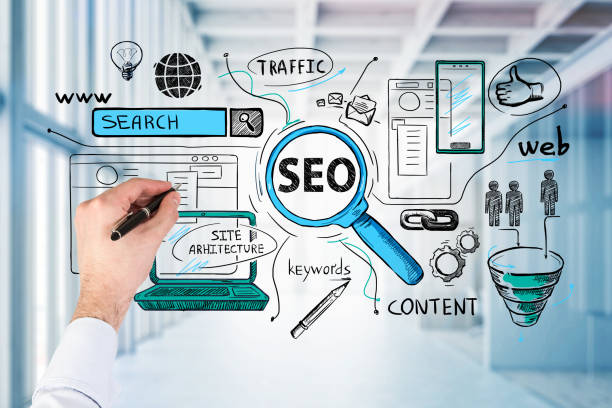
Today, most internet users access websites through mobile devices.
Therefore, optimizing your site for mobile is one of the most important factors in SEO.
Google gives a better rank to sites that are optimized for mobile.
Mobile optimization includes responsive design, using readable fonts, and providing suitable content for mobile devices.
Being mobile-friendly is one of the most important parts of #onpage_seo.
Methods of Mobile Optimization
To optimize your site for mobile, you can use the following methods:
- Using Responsive Design: Responsive design means that your site automatically adapts to the screen size of the user’s device.
- Using Readable Fonts: Use fonts that are easy to read on mobile devices.
- Providing Suitable Content: Your site content should be optimized for mobile devices.
Use short paragraphs, lists, and small images. - Testing the Site on Mobile Devices: Test your site on different mobile devices to make sure it is displayed correctly.
Monitoring and Continuous Improvement of On-Page SEO

Importance of Continuous Monitoring
SEO is an ongoing process and requires continuous monitoring and improvement.
You should regularly check your site’s performance in search results and identify potential problems.
You can use tools such as Google Search Console and Google Analytics for this.
Methods of Continuous Improvement
Using the information you get from monitoring tools, you can improve your on-page SEO strategy.
This may include the following:
- Keyword Optimization
- Improving Content Quality
- Correcting Internal Links
- Improving Site Loading Speed
- Mobile Optimization
Remember that #onpage_seo is a dynamic process and your strategy should also change as search engine algorithms change.
Therefore, you should always be up to date and use the latest SEO techniques and best practices.
Continuous monitoring is very important in on-page SEO.
Frequently Asked Questions
| Question | Answer |
|---|---|
| What is On-page SEO? | On-page SEO refers to the set of actions that are performed within your website to improve its ranking in search engine results. This includes content optimization, site structure, and HTML code. |
| Why is On-page SEO important? | On-page SEO helps search engines understand the content of your page and determine whether your content is relevant to searchers. This is the foundation of any successful SEO strategy. |
| What are the key elements of on-page SEO? | Page title (Title Tag), Meta Description, keyword usage, image optimization, heading structure (H1, H2, …), internal linking, and content quality are key elements. |
| How to optimize the page title (Title Tag)? | The page title should include the main keyword, be attractive and encouraging to click, and its length should be between 50 and 60 characters (or a suitable pixel) to be fully displayed in search results. |
| What role does the meta description play in on-page SEO? | The meta description is a summary of the content of the page that is displayed below the title in search results. Although it does not directly affect ranking, it helps SEO by increasing the click-through rate (CTR). |
| What is the importance of using a heading structure (H1, H2, H3) in on-page SEO? | Headings structure the content of the page and make it easier to read. H1 is usually the main title of the page and should include a keyword. H2 and H3 are used to organize subsections and help search engines understand the content hierarchy. |
| How to use keywords effectively in content? | Keywords should be used naturally and logically throughout the content, including the introduction, body, and conclusion. Avoid over-filling keywords (Keyword Stuffing). |
| What steps does image optimization for on-page SEO include? | It includes compressing images to reduce volume, using descriptive file names, adding appropriate alternative text (Alt Text), and optimizing the image title and description. Alt Text is critical for accessibility and helping search engines understand the content of the image. |
| What is internal linking and what are its benefits? | Internal linking means creating a link from one page on your website to another page on the same website. This helps users easily navigate your site, distributes page authority throughout the site, and helps search engines better understand your site structure. |
| What is the importance of content quality in on-page SEO? | High-quality, accurate, comprehensive, and valuable content for users is the cornerstone of on-page SEO. Search engines prefer content that meets the needs of users. High-quality content leads to more time a user spends on the site (Dwell Time) and reduces the bounce rate, which are positive SEO signals. |
and other services of Rasa Web Advertising Agency in the field of advertising
Smart Conversion Rate Optimization: An innovative platform to improve the increase in click-through rates with custom programming.
Smart Marketing Automation: An innovative platform to improve customer acquisition with custom programming.
Smart Reporting: Professional optimization for analyzing customer behavior using accurate audience targeting.
Smart SEO: A fast and efficient solution to increase site traffic by focusing on attractive user interface design.
Smart Marketing Automation: Professional optimization to increase sales using custom programming.
And more than hundreds of other services in the field of internet advertising, advertising consulting and organizational solutions
Internet Advertising | Advertising Strategy | Advertising Reporting
Resources
On-page SEO Training in Faraz SEO
, What is on-site SEO and why is it important?
,What is on-page SEO? Comprehensive guide to on-page SEO
, What is on-page SEO? [Comprehensive On-Page SEO Guide]
? Transform your business in the digital world and achieve your big goals with Rasaweb Digital Marketing Agency. We pave your way to success by providing services such as professional website design, SEO, and content marketing.
📍 Tehran, Mirdamad Street, next to Central Bank, South Kazerun Alley, Ramin Alley No. 6