
What is On-Page SEO and Why is it Important?

On-Page SEO refers to the set of actions you take within your website to improve the site’s ranking in search engines like Google.
These actions include optimizing content, site structure, HTML tags, and more.
The importance of On-Page SEO is that it helps search engines better understand the content of your site, and as a result, increases your site’s ranking in search results.
In fact, On-Page SEO is the foundation of a successful SEO strategy.
Without strong On-Page SEO, your efforts in #Off_Page_SEO and #Content_Marketing will not be as effective.
The importance of on-page SEO can be summarized in several key aspects:
- Improved ranking in search results: By optimizing content and site structure, you can increase your ranking in Google search results.
- Increased organic traffic: A higher ranking in search results leads to increased organic (natural) traffic to your site.
- Improved user experience: On-Page SEO includes actions that improve user experience, such as faster loading speeds and responsive design.
- Increased conversion rate: Quality traffic and a good user experience can lead to an increased conversion rate and ultimately, increased sales.
Are you worried about the low conversion rate of your online store and not achieving your desired sales?
Rasaweb is your specialized solution for having a successful online store.
✅ Significant increase in conversion rates and sales
✅ Professional and user-friendly design to satisfy customers
⚡ Ready for a transformation in online sales? Get a free consultation!
Keyword Research – Finding Hidden Treasure in User Searches

Keyword research is the cornerstone of On-Page SEO.
Before taking any action, you need to know exactly what words users are searching for to reach your information or product.
There are various tools for this, such as Ahrefs Keywords Explorer, Ubersuggest and Google Keyword Planner.
Using these tools, you can find keywords related to your field, check their search volume, and identify competitive keywords.
When researching keywords, pay attention to the following:
- Relevance: Keywords must be directly related to the content of your site.
- Search Volume: Keywords with high search volume can attract a lot of traffic to your site.
- Competition: Keywords with high competition require more time and effort to rank.
- Long-Tail Keywords: These keywords usually have lower search volume, but have higher conversion rates because they are more specific.
By choosing the right keywords, you can ensure that your site’s content is found by target users, resulting in increased traffic and site ranking.
Optimizing Page Title (Title Tag) and Meta Description
The page title (Title Tag) and meta description are the first things users see in search results.
These two elements play an important role in attracting users and encouraging them to click on your site’s link.
The page title should be short, engaging, and contain the main keyword.
The meta description should be a brief and engaging summary of the page’s content and encourage the user to click on the link.
Important points in optimizing page title and meta description:
- Appropriate length: The page title should not be more than 60 characters and the meta description should not be more than 160 characters.
- Keyword: The main keyword should be in the page title and meta description.
- Attractiveness: The page title and meta description should be attractive and persuasive.
- Relevance: The page title and meta description should be directly related to the content of the page.
- Use of Call to Action: In the meta description, you can use a Call to Action such as “Learn More” or “Buy Now”.
On-Page SEO is very important in this section because search engines use this information to better understand the content of the page and display it in search results.
| Element | Description | Best Practice |
|---|---|---|
| Page Title (Title Tag) | The page title that appears in search results and the browser tab. | Short (less than 60 characters), contains the main keyword, engaging |
| Meta Description | A summary of the page content that appears in search results. | Short (less than 160 characters), engaging, contains the keyword, has a Call to Action |

Content Optimization – Quality Reigns in the Online World

Content is king! This statement is still true in the world of On-Page SEO.
Quality, engaging, and relevant content can attract users to your site, keep them on the site, and increase conversion rates.
Search engines also like quality content and give a higher ranking to sites that provide valuable content.
Important points in content optimization:
- Keyword Research: Create your content based on the keywords that users are searching for.
- Appropriate structure: Use titles, subtitles, paragraphs, and lists to organize content.
- Readability: Write your content in simple and fluent language so that it is understandable for all users.
- Images and Videos: Use images and videos to make the content more attractive.
- Internal Linking: Link to other pages on your site so users can easily navigate your site.
On-Page SEO in this section means creating content that is optimized for both users and search engines.
Does your current site represent your brand’s credibility as it should? Or does it drive away potential customers?
Rasaweb, with years of experience in designing professional corporate websites, is your comprehensive solution.
✅ A modern, beautiful, and brand-aligned site
✅ Significant increase in lead generation and new customers
⚡ Contact Rasaweb now to receive a free corporate website design consultation!
Image Optimization – Hidden Power Behind Pixels
Images play an important role in the attractiveness and understanding of your site’s content.
However, unoptimized images can slow down the site’s loading speed and have a negative impact on #SEO.
By optimizing images, you can both improve the user experience and increase your site’s ranking in search results.
Important points in image optimization:
- Choose the appropriate format: Use JPEG format for high-volume images and PNG format for high-quality, low-volume images.
- Reduce image size: Reduce the size of images without sacrificing quality.
There are many online tools for this. - Use Alt Text: Write a suitable and descriptive Alt Text for each image.
Alt Text helps search engines understand the image and is also useful for users who cannot see the image. - Appropriate File Name: Choose file names for images with keywords related to the image.
On-Page SEO in this section means optimizing images to increase site speed and improve search engine understanding of the site’s content.
URL Optimization – An Eloquent Address to Success
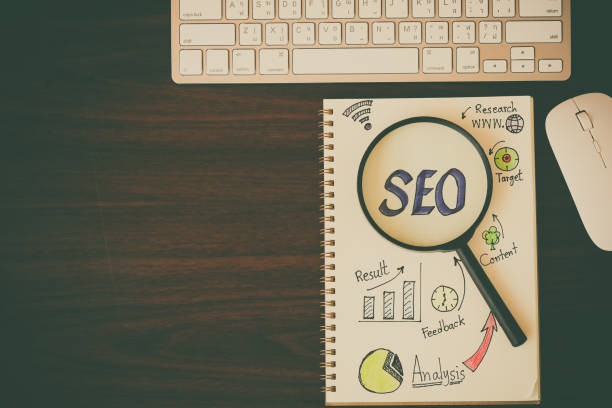
URL or page address is one of the important factors in On-Page SEO.
The URL should be short, readable, and contain the main keyword.
An optimized URL can help search engines better understand the content of the page and also help users understand what page they will be taken to by clicking on the link.
Important points in URL optimization:
- Shortness: The URL should be as short as possible.
- Readability: The URL should be readable and understandable.
- Keyword: The main keyword should be in the URL.
- Use of hyphens: Use hyphens (-) to separate words in the URL.
- Do not use uppercase letters: Use lowercase letters in the URL.
On-Page SEO in this section means creating URLs that are optimized for both users and search engines.
Internal Linking – A Bridge to Other Pages on the Site
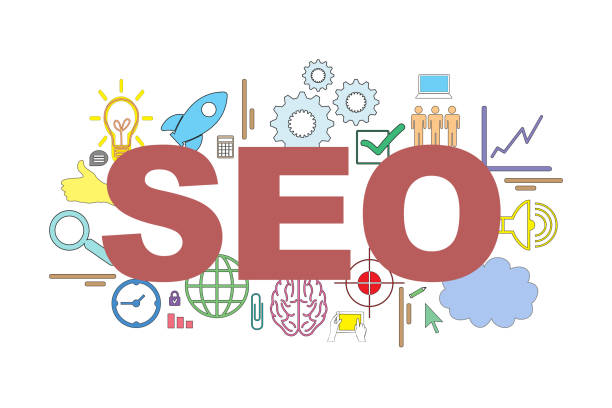
Internal linking means creating links between different pages of your site.
This helps search engines better understand the structure of your site and also helps users easily navigate your site.
Internal linking can have a positive impact on your site’s ranking in search results.
Click here to preview your posts with PRO themes ››
Important points in internal linking:
- Relevance: Links should link to pages that are relevant to the content of the current page.
- Use Appropriate Anchor Text: Anchor Text is the text that the link is attached to.
Use descriptive anchor texts that are relevant to the destination page. - Appropriate Number of Links: Do not use too many links on one page.
- Link to Important Pages: Link to important pages on your site to show their importance to search engines.
On-Page SEO in this section means creating a strong internal linking structure that helps search engines and users easily navigate your site.
| Concept | Description | Example |
|---|---|---|
| Anchor Text | The clickable text that displays a link. | <a href=”https://example.com”>On-Page SEO</a> |
| Internal Link | Links that point to other pages on the same domain. | Link from a product page to a blog page |
| External Link | Links that point to other pages on different domains. | Link from your blog to a reputable source on another website |
Site Speed Optimization – Speed to Outperform Competitors

Site speed is one of the important factors in Google ranking.
Users expect a site to load quickly, and if your site is slow, users are more likely to leave it.
Google also gives a better ranking to sites that have high loading speed.
Important points in optimizing site speed:
- Image Optimization: High-volume images can slow down the site.
Optimize your images. - Use CDN: Use a Content Delivery Network (CDN) to load content faster from servers close to users.
- Enable Cache: By enabling Cache, you can store the site’s content in users’ browsers so that the site loads faster on subsequent visits.
- Reduce Code Volume: Reduce the volume of HTML, CSS, and JavaScript code on your site.
- Choose Appropriate Hosting: Use high-quality and fast hosting.
On-Page SEO in this section means taking actions that increase site speed and improve user experience.
Does your company’s site make a professional and lasting first impression on potential customers? Rasaweb, with professional corporate website design, not only represents your brand’s credibility, but also opens a path for your business to grow.
✅ Create a strong and reliable brand image
✅ Attract target customers and increase sales
⚡ Get a free consultation
Responsive Design – A Site for All Devices
Today, most users access the Internet through mobile devices.
Therefore, responsive design is very important.
Responsive design means that your site should automatically adapt to the screen size of the user’s device.
If your site is not responsive, users who visit your site via mobile devices will have a poor user experience and are more likely to leave the site.
Important points in responsive design:
- Use Media Queries: Use Media Queries in CSS to set different styles for different devices.
- Mobile-First Design: First design the site for mobile devices and then optimize it for larger devices.
- Test on different devices: Test your site on different devices with different screen sizes.
On-Page SEO in this section means creating a site that is accessible and usable for all users, regardless of the device they are using.
On-Page SEO helps you rank better in Google. On-Page SEO is a powerful tool for increasing your site traffic. On-Page SEO, with proper planning, can boost your business. On-Page SEO is a long-term investment. On-Page SEO is an ongoing process.
Schema Markup Optimization – Structured Data for Better Understanding
Schema Markup is a code that helps search engines better understand your site’s content.
Using Schema Markup, you can provide additional information about your page’s content to search engines, such as the type of content, author, date of publication, etc.
This information can help Google display your site better in search results and increase click-through rate (CTR).

Click here to preview your posts with PRO themes ››
Different types of Schema Markup:
- Article: For news and blog articles
- Product: For product pages
- Review: For user reviews
- Event: For events
- Local Business: For local businesses
On-Page SEO in this section means using Schema Markup to provide accurate and structured information about the site’s content to search engines.
On-Page SEO helps your website get seen. On-Page SEO plays a very important role in the success of an online business. On-Page SEO is a key element in digital marketing strategy. On-Page SEO can provide a better user experience. On-Page SEO is complemented by strong content. On-Page SEO should always be considered.
Frequently Asked Questions
| Question | Answer |
|---|---|
| What is On-Page SEO? | It refers to the set of actions that are taken within a website to improve the ranking in search engines. |
| Why is On-Page SEO important? | Because it helps search engines better understand the content and structure of your site and improves user experience. |
| What are the most important elements of On-Page SEO? | Title and meta descriptions, keywords, URL structure, quality content, image optimization, internal linking, and site speed. |
| How do we optimize the Title Tag and Meta Description? | The title should include the main keyword and be attractive, and the meta description should be a compelling summary of the content with relevant keywords. |
| What is the role of keywords in On-Page SEO? | Keywords tell search engines what the page is about and should be used naturally and intelligently in the text. |
| How is image optimization done for On-Page SEO? | By compressing the size, using a descriptive file name, and filling in the Alt tag with relevant descriptions and keywords. |
| What is Internal Linking and what is its purpose? | Connecting different pages of the site to each other. This helps distribute page authority and improves search engine crawling. |
| What is the importance of site loading speed in On-Page SEO? | High speed improves user experience and is an important ranking factor for search engines like Google. |
| What effect does the site being Responsive (Mobile-Friendliness) have on On-Page SEO? | Given the increase in mobile users, being responsive is essential to provide a good user experience on all devices and for Google’s mobile-first indexing. |
| What are the important factors related to content in On-Page SEO? | Originality, quality, comprehensiveness, readability, appropriate use of headings (H1, H2,…) and regular content updates. |
And other services of Rasa Web Advertising Agency in the field of advertising
Smart Reporting: A new service to increase customer acquisition through marketing automation.
Smart Advertising Campaign: Designed for businesses looking to manage campaigns through attractive UI design.
Smart Direct Marketing: A fast and efficient solution for customer acquisition with a focus on intelligent data analysis.
Smart Marketplace: An innovative platform to improve site visits with attractive UI design.
Smart Conversion Rate Optimization: Designed for businesses looking to increase sales through intelligent data analysis.
And more than hundreds of other services in the field of Internet advertising, advertising consulting and organizational solutions
Internet Advertising | Advertising Strategy | Advertorials
Sources
What is On-Page SEO and why is it important?
,What is On-Page SEO? A comprehensive and practical guide 2024
,What is On-Page SEO and why is it important? Comprehensive guide + On-Page SEO Techniques
,Complete On-Page SEO training | 0 to 100 On-Page SEO
? Are you ready to transform your business in the digital world? With Rasaweb Afrin, a specialist in SEO-optimized website design and comprehensive digital marketing strategies, reach the peak of success.
📍 Tehran, Mirdamad Street, next to the Central Bank, South Kazerun Alley, Ramin Alley No. 6