
What is On-Page SEO and Why Does It Matter?
On-Page SEO refers to the set of actions taken to optimize website pages to improve their ranking in Google and other search engine results.
These actions include optimizing content, website structure, HTML tags, and other page-related elements.
Why is On-Page SEO important? Imagine you own a shop.
If your shop’s decoration isn’t appealing and the products aren’t arranged correctly, you’ll attract fewer customers.
On-Page SEO works similarly.
If your website isn’t optimized for search engines, you won’t rank well in search results and will receive less organic traffic.
In today’s digital world, #SEO is a necessity.
On-Page SEO not only helps improve site ranking but also enhances user experience.
When users can easily find the information they need on your site, they spend more time on the site, and their likelihood of returning increases.
In other words, On-Page SEO helps you turn your website into a valuable resource for users.
To better understand the importance of On-Page SEO, consider that Google and other search engines strive to provide users with the best and most relevant results.
On-Page SEO helps you show search engines that your website is relevant and valuable and deserves a higher ranking in search results.
So, if you’re looking to increase organic traffic and improve your site’s ranking, take On-Page SEO seriously.
Are your online sales not what you expect? With Rasaweb, solve the problem of low sales and poor user experience forever!
✅ Increase visitor-to-customer conversion rates
✅ Create a pleasant user experience and increase customer trust
⚡ Take action now for a free consultation!
Keyword Research: The First Step in On-Page SEO
Keyword Research is the process of identifying and analyzing the words and phrases that users use to search for information on search engines.
This process is one of the most important steps in On-Page SEO because it helps you create website content based on users’ needs and interests.
Without keyword research, your efforts for On-Page SEO may be ineffective.

Click here to preview your posts with PRO themes ››
To begin keyword research, you must first have a good understanding of your business and audience.
What questions might users have about your products or services? What words do they use to find relevant information? To answer these questions, you can use various keyword research tools such as Google Keyword Planner, Ahrefs, and SEMrush.
These tools help you find keywords related to your business and examine their search volume and competition.
After identifying keywords, you should categorize them based on their importance and relevance to your website content.
Then, you can use these words in titles, meta descriptions, text content, images, and other page elements.
Keep in mind that using too many keywords (Keyword Stuffing) can backfire and harm your site’s ranking.
Instead of focusing on the number of keywords, focus on the quality and relevance of your content to users’ needs.
Keyword Research Tools can be a good guide in this area.
Optimizing Titles and Meta Descriptions
Title Tags and Meta Descriptions are two important elements in On-Page SEO that appear in Google search results.
Titles are the first thing users see in search results and play an important role in attracting them to click on your website link.
Meta descriptions also provide a summary of the page’s content and can help users decide whether this page is relevant to their needs.
To optimize titles, you should use relevant and attractive keywords.
Titles should be short, concise, and descriptive and tell users what they will find on this page.
Titles should not exceed 60 characters because Google usually shortens longer titles.
To optimize meta descriptions, you should provide an engaging and accurate summary of the page’s content.
Meta descriptions should give users a reason to click on your website link.
Meta descriptions should not exceed 160 characters.
Click here to preview your posts with PRO themes ››
Remember that titles and meta descriptions should be unique and different for each website page.
Avoid using duplicate titles and meta descriptions as this can harm your site’s ranking.
On-Page SEO can be very effective by following these simple tips.
Here is a table that summarizes the key points:
| Element | Description | Best Practices |
|---|---|---|
| Title Tag | Text displayed in search results. | Use keywords, be short and attractive, less than 60 characters |
| Meta Description | A summary of the page’s content. | Accurate and engaging summary, a reason to click, less than 160 characters |
Optimizing Content for On-Page SEO
Content is king! You have heard this sentence many times, and the reality is that quality and relevant content is one of the most important factors in On-Page SEO.
Your content should be valuable to users and answer their questions.
Also, it should be optimized for search engines to be able to rank well in search results.
Proper On-Page SEO helps produce valuable content.
To optimize content, you should use relevant keywords naturally and intelligently in the text.
Avoid overusing keywords as this may cause Google to penalize your website.
Instead of focusing on the number of keywords, focus on the quality and relevance of your content to users’ needs.
Your content should be readable, fluent, and engaging and help users easily find the information they need.
In addition to keywords, you should also pay attention to the structure of your content.
Use titles and subtitles to organize content and use short and readable paragraphs.
Use images, videos, and other multimedia elements to make the content more attractive.
Also, pay attention to internal and external linking.
Internal linking helps search engines better understand the structure of your website, and external linking to reputable websites can help with your website’s credibility.
Does your current site reflect your brand’s credibility as it should? Or does it drive away potential customers?
Rasaweb, with years of experience in designing professional corporate websites, is your comprehensive solution.
✅ A modern, beautiful site tailored to your brand identity
✅ Significant increase in lead generation and new customers
⚡ Contact Rasaweb now for a free corporate website design consultation!
Optimizing Images for On-Page SEO
Images play an important role in the attractiveness and user experience of a website.
But images can also have a positive impact on On-Page SEO.
To optimize images, you should pay attention to a few things.
First, you should save your images with appropriate filenames.
The filename should be descriptive and relevant to the content of the image.
For example, instead of using a name like “IMG_1234.jpg”, use a name like “Mount-Damavand.jpg”.
Second, you should use Alt tags for images.
The Alt tag is text that is displayed to users if the image is not displayed.
The Alt tag should be descriptive and relevant to the content of the image and contain relevant keywords.
For example, if you have an image of Mount Damavand, its Alt tag could be “Image of Mount Damavand”.
Third, you should reduce the size of your images.
High-resolution images can slow down your website’s loading speed and affect the user experience.
To reduce the size of images, you can use image compression tools.
You can also use appropriate image formats such as JPEG for images with many colors and PNG for images with few colors.
Image optimization is an important aspect of On-Page SEO that is often overlooked.
Moz has good resources for learning more about this.
URL Structure and Permalinks

URL (Uniform Resource Locator) structure or web address and permalinks play an important role in On-Page SEO.
URLs should be readable, concise, and descriptive and contain relevant keywords.
For example, instead of using a URL like “example.com/?p=123”, use a URL like “example.com/comprehensive-on-page-seo-guide”.
Permalinks should be fixed and permanent.
Changing permalinks can cause old links to break and reduce your website’s traffic.
If you have to change permalinks, you should use a 301 redirect to redirect users and search engines to the new address.
The best practice for URL structure is to use a hierarchical structure.
This means that URLs should have a logical and organized structure and show where the page is located on the website.
For example, the URL of a page about On-Page SEO could be: “example.com/seo/on-page-seo”.
On-Page SEO with improving URL structure will have a significant impact on site ranking.
Optimizing Page Load Speed

Page load speed is an important factor in user experience and On-Page SEO.
Users expect website pages to load quickly, and if a page takes too long to load, users are more likely to leave the page.
Google also considers page load speed as one of the ranking factors.
To optimize page load speed, you can take various measures.
First, you should reduce the size of your images.
Second, you should use file compression (Gzip Compression).
Third, you should use caching.
Fourth, you should use a CDN (Content Delivery Network).
Fifth, you should optimize your HTML, CSS, and JavaScript code.
There are various tools to test page load speed.
These tools include Google PageSpeed Insights, GTmetrix, and Pingdom Website Speed Test.
Using these tools, you can identify and fix problems with your page load speed.
Here is a table that shows some of the factors affecting page load speed and their optimization solutions:
| Factor | Optimization Solution |
|---|---|
| Image Size | Reduce image size using compression tools and appropriate formats |
| File Compression | Use Gzip Compression to compress HTML, CSS, and JavaScript files |
| Caching | Use Caching to store static files and reduce server load |
| CDN | Use CDN to distribute content across different servers and reduce load time |
| HTML, CSS, and JavaScript Code | Optimize and Minify codes to reduce file sizes |
Responsive Design and Mobile Compatibility
With the increasing use of mobile devices, Responsive Design and Mobile-Friendly have become important factors in On-Page SEO.
Responsive design means that your website should automatically adapt to the screen size of different devices (such as mobile, tablet, and desktop).
Google gives mobile-friendly websites a better ranking and prefers them in search results.
To make sure your website is responsive, you can use Google’s Mobile-Friendly Test tool.
This tool shows you how your website appears on mobile devices and what problems it has.
You can also use CSS frameworks like Bootstrap to create responsive layouts.
On-Page SEO with responsive design means that mobile users should be able to easily navigate your website and access the information they need.
Menus should be simple and touch-friendly, buttons should be large and clickable, and texts should be readable and understandable.
Mobile compatibility is no longer an option, but a necessity.
Are you unhappy with the low rate of converting visitors to customers on your online store?
Solve this problem forever with a professional online store website design by Rasaweb!
✅ Increase visitor-to-customer conversion rates
✅ Create an excellent user experience and build customer trust
⚡ Get a free consultation
Internal and External Linking
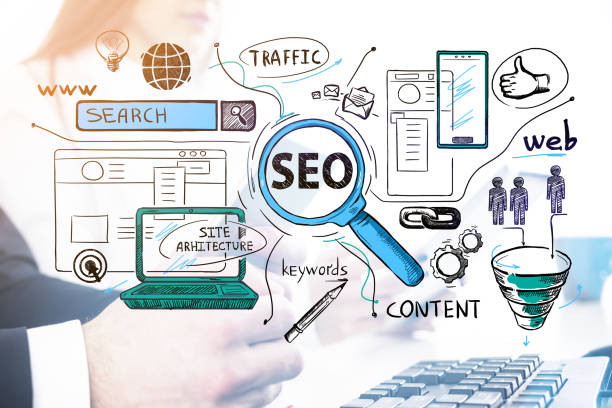
Internal Linking and External Linking are two important strategies in On-Page SEO that help improve your website’s ranking in search results.
Internal linking means linking from one page of your website to another page.
This helps search engines better understand your website’s structure and recognize the connection between different pages.
Also, internal linking helps users easily navigate your website and access the information they need.
External linking means linking from your website to other websites.
Linking to reputable and relevant websites can help with your website’s credibility and show search engines that your website is a valuable resource.
However, you should be careful to only link to reputable and relevant websites and avoid linking to spam and low-quality websites.
Semrush provides useful articles on linking.
When linking, use appropriate anchor text.
The anchor text should be descriptive and relevant to the content of the page you are linking to.
Avoid using general anchor texts like “click here”.
On-Page SEO in this section emphasizes choosing the right anchor text.
Continuous Review and Improvement of On-Page SEO
On-Page SEO is an ongoing process and should not be viewed as a one-time project.
After taking initial actions for On-Page SEO, you should regularly review your website’s performance and identify weaknesses.
There are various tools to review website performance, including Google Analytics and Google Search Console.
Using these tools, you can obtain information about website traffic, keyword ranking, bounce rate, and other important metrics.
Based on the information you obtain, you can take the necessary steps to improve your website’s On-Page SEO.
You may need to update the content of your pages, target new keywords, improve the structure of URLs, or optimize page load speed.
On-Page SEO requires continuous review and making necessary changes to improve performance.
Remember that search engine algorithms are constantly changing, and On-Page SEO must also adapt to these changes.
For this reason, you should regularly read news and articles related to On-Page SEO and be aware of the latest techniques and methods.
On-Page SEO is a long-term investment that can help you increase your website’s organic traffic and achieve your business goals.
Frequently Asked Questions
| Number | Question | Answer |
|---|---|---|
| 1 | What is On-Page SEO? | On-Page SEO refers to the set of actions taken within the website to optimize its pages to achieve a better ranking in search results. |
| 2 | What is the most important factor in On-Page SEO? | High-quality, relevant, and comprehensive content that meets the user’s needs is the most important factor in On-Page SEO. |
| 3 | What role does the Title Tag play in On-Page SEO? | The Title Tag is one of the most important factors that tells search engines and users what the page’s content is about. It should include the main keyword and be attractive. |
| 4 | How important is the Meta Description Tag? | Although it does not directly affect ranking, it is very effective in click-through rate (CTR) in search results and encourages users to visit the page. |
| 5 | How is image optimization done in On-Page SEO? | By using an appropriate alt tag, compressing the image size to increase loading speed, and meaningful naming of the image file. |
| 6 | What is the importance of using headings (H1, H2, H3) in On-Page SEO? | Headings help structure content, increase readability, and help search engines understand the hierarchy and sub-topics of the content. |
| 7 | What does internal linking mean and what are its benefits? | Internal linking means creating links between different pages of a website. This helps distribute authority, improve user navigation, and help search engine crawling. |
| 8 | Where should the main keyword (Focus Keyword) be placed on the page? | The main keyword should be placed in the Title Tag, Meta Description, H1, first paragraph, and naturally throughout the text, and if possible, in the URL address. |
| 9 | What effect does duplicate content have on On-Page SEO? | Duplicate content can harm the site’s ranking and confuse search engines about which version is the original and may be flagged as spam. |
| 10 | How important is page load speed in On-Page SEO? | Page load speed is an important ranking factor and directly affects the user experience. Slow pages increase the bounce rate of users. |
And other services of Rasa Web Advertising Agency in the field of advertising
Smart Direct Marketing: A new service for increasing online growth through marketing automation.
Smart Linking: A dedicated service to grow user engagement based on optimizing key pages.
Intelligent Marketing Automation: Designed for businesses looking to attract customers through SEO-driven content strategy.
Smart Advertising Campaign: Designed for businesses looking to engage users through user experience customization.
Intelligent Custom Software: Transform SEO ranking with the help of marketing automation.
And more than hundreds of other services in the field of Internet advertising, advertising consulting, and organizational solutions
Internet advertising | Advertising strategy | Advertorials
Resources
The Ultimate Guide to On-Page SEO from Semrush
,What is On-Page SEO? And How to Do It? from Ahrefs
,On-Page Optimization from Moz
,Guide To On-Page SEO from Search Engine Land
? With Rasaweb Digital Marketing Agency, transform your business in the digital world and achieve your big goals. We pave the way for your success by providing services such as professional website design, SEO, and content marketing.
📍 Tehran, Mirdamad Street, next to the Central Bank, South Kazerun Alley, Ramin Alley No. 6
“`