
What is On-Page SEO and Why Does It Matter?
On-Page SEO refers to the set of actions you take within your website to improve its ranking in search engines like Google.
These actions include optimizing content, site structure, HTML tags, and other elements present on your web pages.
The importance of On-Page SEO lies in the fact that it helps search engines better understand your website’s content and display it to relevant users.
In fact, On-Page SEO tells search engines what your site is about and what value it offers to users.
By optimizing the internal factors of your site, you can increase your chances of being seen in search results and attract more traffic to your site.
On-Page SEO also plays an important role in User Experience (UX).
When your site is optimized for users, they can more easily find the information they need and have a better interaction with the site.
This positive interaction can lead to increased conversion rates and customer loyalty.
One of the most important aspects of On-Page SEO is content optimization.
High-quality and relevant content not only attracts users but also shows search engines that your site is a valuable and reliable resource.
To optimize content, you need to use appropriate keywords, write attractive and descriptive titles, and organize your content in a way that makes it easy for users to read and understand.
This content strategy helps search engines understand the value of your content and increase its ranking in search results.
In addition to content, site structure is also very important in On-Page SEO.
A logical and organized structure helps users and search engines easily navigate your site and find the pages they are looking for.
To create a suitable structure, you should use clear navigation menus and internal links.
Also, you need to make sure your site is optimized for mobile, as many users today access the internet through their mobile phones.
On-Page SEO ultimately helps create a user-friendly and search engine-friendly site that can contribute to the success of your online business.
Are you losing business opportunities because of an outdated website? With Rasaweb, solve the problem of not attracting potential customers through your website forever!
✅ Attract more high-quality leads
✅ Increase brand credibility in the eyes of customers
⚡ Get a free consultation for corporate website design
Keyword Research for On-Page SEO

Keyword research is the cornerstone of any successful On-Page SEO strategy.
Without a proper understanding of the words that users use to search for information about your products or services, you cannot optimize your content and achieve a good ranking in search results.
The keyword research process involves identifying and analyzing the words that users are most likely to use when searching on Google or other search engines.

Click here to preview your posts with PRO themes ››
To start keyword research, you can use various tools such as Ahrefs, SEMrush, Google Keyword Planner, and Ubersuggest.
These tools help you find keywords related to your business, check their search volume, and evaluate the level of competition for each keyword.
You can also use Google Trends to identify search trends and popular keywords.
When choosing keywords, you should pay attention to two important factors: search volume and competition.
Keywords with high search volume can attract a lot of traffic to your site, but the competition for these keywords is usually very high.
On the other hand, keywords with lower search volume have less competition, and it is easier to rank for them in search results.
The best strategy is to target a combination of high and low search volume keywords.
In addition, you should also pay attention to searcher intent.
Searcher intent refers to the user’s goal when searching for a specific keyword.
For example, a user who searches for the keyword “buy laptop” is likely intending to buy a laptop.
While a user who searches for the keyword “best laptops” is probably researching and reviewing different laptop models.
You should optimize your content based on searcher intent to meet their needs and achieve a good ranking in search results.
After finding suitable keywords for On-Page SEO content, you should carefully use them in the content structure.
Optimizing Page Title and Meta Descriptions

The Page Title (Title Tag) and Meta Description are among the most important HTML elements that play a significant role in your site’s On-Page SEO.
The Page Title is the text that appears in the browser’s title bar and in search results.
The Meta Description is a summary of the page’s content that is displayed below the Page Title in search results.
These two elements help search engines better understand your page’s content and also show users what your page is about.
Click here to preview your posts with PRO themes ››
To optimize the Page Title, you should use keywords related to the page’s content, but the Page Title should also be attractive and descriptive.
The length of the Page Title should be between 50 and 60 characters so that it is fully displayed in search results.
Also, you should avoid repeating keywords in your Page Title, as this can harm your site’s SEO.
The Page Title should be unique and relevant to the page’s content.
To optimize the Meta Description, you should write an accurate and attractive summary of your page’s content.
The Meta Description should encourage users to click on your page’s link in search results.
The length of the Meta Description should be between 150 and 160 characters.
Also, you should use keywords related to the page’s content in your Meta Description, but avoid repeating them.
The Meta Description should be unique and relevant to the page’s content.
Meta descriptions and page titles can help you improve your On-Page SEO strategy.
An optimized Page Title can increase Click-Through Rate (CTR) and attract more traffic to your site.
An attractive Meta Description can also encourage users to click on your page’s link and use your content.
Therefore, optimizing the Page Title and Meta Description is one of the most important steps you can take to improve your site’s SEO.
Ultimately, these two elements have a significant impact on your visibility in searches.
| Feature | Description |
|---|---|
| Page Title (Title Tag) | Text that appears in the browser’s title bar and search results |
| Meta Description | A summary of the page’s content that appears below the title in search results |
Optimizing Images for SEO

Optimizing images is an important aspect of On-Page SEO that is often overlooked.
High-quality and relevant images can improve the user experience and make your content more attractive.
But if the images are not properly optimized, they can slow down page loading speed and harm your site’s SEO.
To optimize images, you need to pay attention to a few important points.
The first point is to choose the appropriate format for the images.
JPEG and PNG formats are the most common image formats on the web.
The JPEG format is suitable for images with many colors, such as photos, because its file size is smaller.
The PNG format is suitable for images with few colors and text because it preserves the image quality.
To choose the appropriate format, you need to pay attention to the type of image and the desired quality.
The second point is image compression.
Image compression means reducing their file size without losing much quality.
By compressing images, you can improve page loading speed and enhance the user experience.
There are various tools for compressing images that you can use.
TinyPNG is one of these tools that helps you compress your PNG and JPEG images for free.
The third point is to use Alt Text for images.
Alt Text is the text that is displayed instead of the image if it fails to load.
Also, Alt Text helps search engines understand the content of the image and display it to relevant users.
To write Alt Text, you should use keywords related to the image, but the text should also be descriptive and relevant to the content of the image.
This Alt Text should accurately describe what the image is about and how it relates to the page’s text.
In addition, the image file name is also important.
Before uploading an image to your site, change its file name to a descriptive name that is relevant to the content of the image.
Avoid using default names like IMG_1234.jpg.
For example, if your image is about a particular type of flower, change its file name to “red-rose-flower.jpg”.
This helps search engines better understand your image and display it to relevant users.
By following these tips, you can optimize your images and improve your site’s SEO.
As a result, your On-Page SEO will be stronger.
Are you tired of having visitors to your online store but no sales? Rasaweb solves your main problem with professional online store designs!
✅ Significant increase in sales with targeted design
✅ Flawless user experience for your customers
⚡ Get a free consultation!
Optimizing Site Speed

Site speed is one of the important factors in On-Page SEO and user experience.
If your site is slow, users will get tired of it and go to other sites.
Also, Google considers site speed as a ranking factor and places slow sites lower in the rankings.
To optimize site speed, you need to pay attention to a few important points.
The first point is to choose a suitable host.
Your host should be fast and reliable to be able to manage your site’s traffic well.
Avoid shared hosting with limited resources and look for VPS hosting or dedicated servers.
Reputable hosting can have a significant impact on your site’s speed.
You should also pay attention to the geographical location of your host’s server.
Your host’s server should be located close to your users so that your site’s loading speed is faster for them.
The second point is to use an optimized Content Management System (CMS).
WordPress is one of the most popular CMSs in the world, but if it is not properly optimized, it can slow down your site.
Use lightweight and optimized themes and avoid installing unnecessary plugins.
Too many plugins can significantly slow down your site.
You should also regularly update your CMS to take advantage of the latest optimizations and security fixes.
The third point is to enable caching.
Caching means storing a copy of your site’s pages in temporary memory.
When a user visits a page on your site, instead of reloading the page from the server, your site loads the cached version of it.
This significantly increases the page loading speed.
There are various plugins for enabling caching in WordPress that you can use, such as W3 Total Cache and WP Super Cache.
Improving site speed using these methods can have a positive impact on On-Page SEO.
The fourth point is image optimization, which we talked about earlier.
Large and unoptimized images can significantly slow down page loading speed.
Therefore, you should compress your images with the appropriate format and use Alt Text for them.
By following these tips, you can optimize your site speed and improve the user experience.
This not only helps your site’s SEO but also encourages more users to stay on your site and interact with your content.
Suitable URL Structure for SEO

The URL structure is one of the important factors in On-Page SEO that is often overlooked.
A suitable URL structure can help search engines better understand your page’s content and also show users what your page is about.
To create a suitable URL structure, you need to pay attention to a few important points.
The first point is to use keywords in the URL.
Your URL should include keywords related to the page’s content.
This helps search engines understand what your page is about and display it to relevant users.
For example, if your page is about “SEO tutorial,” your URL could be “example.com/seo-tutorial.”
The second point is to keep the URL short.
Long and complex URLs can be confusing for users and search engines.
Try to keep your URLs short and concise.
For example, instead of using the URL “example.com/blog/category/tutorial/seo/beginners/comprehensive-on-page-seo-guide,” use the URL “example.com/seo-tutorial.”
The third point is to use hyphens (-) instead of underscores (_).
Search engines consider hyphens as word separators in URLs, but they consider underscores as a single character.
Therefore, to separate words in your URL, use hyphens.
For example, instead of using the URL “example.com/seo_tutorial,” use the URL “example.com/seo-tutorial.”
The fourth point is to use lowercase letters in the URL.
Some servers are sensitive to uppercase and lowercase letters in URLs and may not correctly recognize URLs with uppercase letters.
To avoid this problem, use lowercase letters in your URL.
For example, instead of using the URL “example.com/SEO-Tutorial,” use the URL “example.com/seo-tutorial.”
By following these tips, you can optimize your site’s URL structure and improve your site’s SEO.
A suitable URL structure not only helps your site’s SEO but also makes it easier for users to share and link to your site’s pages.
These URLs play an important role in On-Page SEO.
Internal Linking

Internal linking means creating links between different pages of your own site.
This helps search engines better understand your site’s structure and also helps users easily navigate your site and find the pages they are looking for.
Internal linking is one of the most important aspects of On-Page SEO that is often overlooked.
To do internal linking, you need to look for opportunities to link to other pages of your site in your content.
Whenever you mention a topic in your content that is explained in detail on another page of your site, link to that page.
For example, if you are talking about “white hat SEO” in an article and you have another page on your site that is completely dedicated to this topic, link to that page.
When creating internal links, you should use appropriate Anchor Text.
Anchor Text is the text that is displayed as the link.
The Anchor Text should be relevant to the content of the page you are linking to.
For example, if you are linking to the “white hat SEO” page, the Anchor Text could be “white hat SEO” or “white hat SEO tutorial.”
Avoid using generic Anchor Texts like “click here” or “read more,” because these texts do not help search engines understand the content of the linked page.
Strengthen On-Page SEO with internal linking.
Internal linking not only helps your site’s SEO but also improves the user experience.
When users can easily navigate your site and find the pages they are looking for, they are more likely to stay on your site and interact with your content.
This positive interaction can lead to increased conversion rates and customer loyalty.
Therefore, internal linking is a valuable investment for improving your site’s SEO and user experience.
| Advantage | Explanation |
|---|---|
| Improved Ranking | Search engines better understand the site’s content. |
| Improved User Experience | Users easily navigate the site. |
| Increased Conversion Rate | Users stay on the site longer, and the likelihood of purchasing increases. |
Optimizing for Mobile
Optimizing for mobile is one of the most essential steps for any website that wants to succeed in today’s world.
Today, more than half of internet traffic comes from mobile devices, and this trend is continuing to increase.
If your site is not optimized for mobile, mobile users will have a bad user experience and will quickly leave your site.
Also, Google considers optimizing for mobile as an important ranking factor and places sites that are not optimized for mobile lower in the rankings.
Therefore, optimizing for mobile is a necessity for On-Page SEO and online success.
To optimize your site for mobile, you should use Responsive Design.
Responsive design means that your site automatically adapts to the screen size of different devices.
By using responsive design, you can make sure that your site is displayed well on any device, including mobile phones, tablets, and desktop computers.
You can design a responsive site using Bootstrap.
In addition to responsive design, you should also pay attention to your site’s loading speed on mobile devices.
Mobile users usually use the internet at a lower speed than desktop computer users.
Therefore, you need to make sure that your site loads quickly on mobile devices.
To do this, you can use various techniques such as compressing images, enabling caching, and using Content Delivery Networks (CDNs).
Also, you need to make sure that your site is optimized for touch.
Mobile users use their fingers to interact with your site.
Therefore, you need to make sure that the buttons and links on your site are large enough and that there is enough space between them so that users can easily touch them.
By following these tips, you can optimize your site for mobile and provide a better user experience for your mobile users.
This not only helps your site’s SEO but also encourages more users to stay on your site and interact with your content.
Take mobile On-Page SEO seriously.
Did you know that 94% of users’ first impressions of a business are related to its website design? With professional corporate website design by **Rasaweb**, turn this first impression into an opportunity for growth.
✅ Attract more customers and increase sales
✅ Create credibility and trust in the eyes of the audience⚡ Get a free website design consultation!
Using Schema Markup

Schema Markup is an HTML code that you can add to your site’s pages to help search engines better understand your page’s content.
Schema Markup provides search engines with more information about the type of content, topic, and other details related to your page.
This information can help search engines display your page to more relevant users and increase your click-through rate (CTR).
Using Schema Markup is an advanced On-Page SEO technique that can have a significant impact on your site’s ranking.
There are different types of Schema Markup, each suitable for a specific type of content.
For example, there is Schema Markup for news articles, products, events, recipes, reviews, and more.
To use Schema Markup, you need to find the code for your content type and add it to your site’s pages.
There are various tools for generating Schema Markup code that you can use, such as Google’s Structured Data Markup Helper.
When using Schema Markup, you need to make sure that the information you provide is accurate and correct.
Incorrect information can harm your site’s SEO.
Also, you should avoid using Schema Markup to deceive search engines.
Using Schema Markup to display false or irrelevant information can lead to your site being penalized by Google.
So use it carefully and strategically and benefit from it in On-Page SEO.
Schema Markup can help you stand out in search results and attract more traffic to your site.
By using Schema Markup, you can provide more information about your site to search engines and increase the chance of your site being seen in search results.
This can lead to increased click-through rates, traffic, and ultimately, your sales.
For this reason, using Schema Markup is a valuable investment for improving your site’s SEO and online success.
You can use schema.org to build structured data.
Monitoring and Measuring On-Page SEO Results
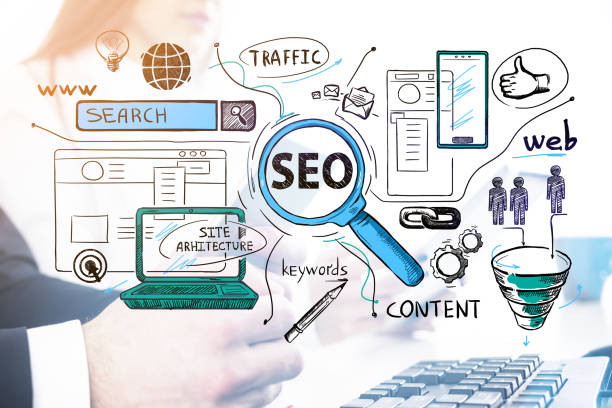
Monitoring and measuring On-Page SEO results is one of the most important steps in any SEO strategy.
Without monitoring and measuring, you cannot know whether your SEO efforts are effective or not.
Also, you cannot identify problems and opportunities on your site and optimize your SEO strategy.
Monitoring and measuring SEO results helps you make more informed decisions about your site’s SEO and achieve better results.
To monitor and measure SEO results, you need to use various tools.
Google Analytics is one of the most powerful and widely used web analytics tools that you can use to track site traffic, user behavior, and other important metrics.
Google Search Console is also a free tool from Google that gives you information about how your site is seen in search results.
By using Google Search Console, you can see the keywords that users use to find your site, the pages that get the most traffic, and other useful information.
In addition, you can use other tools such as Ahrefs Site Audit and SEMrush Site Audit to identify technical and SEO problems on your site.
These tools help you find site errors, broken links, duplicate content, and other problems and fix them.
You can also use these tools to check competitors and identify new SEO opportunities.
When monitoring and measuring SEO results, you should pay attention to various metrics.
Organic traffic, keyword rankings, click-through rate (CTR), bounce rate, and time on site are among the most important metrics that you should track.
By monitoring and measuring these metrics, you can know whether your SEO strategy is effective or not and optimize it if necessary.
Remember that SEO is an ongoing process and requires monitoring, measuring, and optimizing.
Frequently Asked Questions
| Question | Answer |
|---|---|
| What is On-page SEO? | On-page SEO refers to the set of actions taken within your website to improve its ranking in search engine results. This includes optimizing content, site structure, and HTML code. |
| Why is on-page SEO important? | On-page SEO helps search engines understand your page’s content and determine if your content is relevant to searchers. It is the foundation of any successful SEO strategy. |
| What are the key elements of on-page SEO? | Key elements include page titles (Title Tag), meta descriptions (Meta Description), keyword usage, image optimization, heading structure (H1, H2, …), internal linking, and content quality. |
| How do we optimize a page title (Title Tag)? | The page title should include the main keyword, be attractive and enticing to click, and be between 50 and 60 characters (or an appropriate number of pixels) to be fully displayed in search results. |
| What role does the meta description play in on-page SEO? | The meta description is a summary of the page’s content that appears below the title in search results. Although it does not directly affect ranking, it helps SEO by increasing the click-through rate (CTR). |
| What is the importance of using a heading structure (H1, H2, H3) in on-page SEO? | Headings structure the page content and make it easier to read. H1 is usually the main title of the page and should include the keyword. H2 and H3 are used to organize subsections and help search engines understand the content hierarchy. |
| How to use keywords effectively in content? | Keywords should be used naturally and logically throughout the content, including the introduction, body, and conclusion. Avoid over-stuffing keywords (Keyword Stuffing). |
| What steps are involved in optimizing images for on-page SEO? | This includes compressing images to reduce size, using descriptive file names, adding appropriate Alt Text, and optimizing the image title and description. Alt Text is vital for accessibility and helping search engines understand the content of the image. |
| What is internal linking and what are its benefits? | Internal linking means creating a link from one page on your website to another page on the same website. This helps users easily navigate your site, distributes page authority throughout the site, and helps search engines better understand your site structure. |
| What is the importance of content quality in on-page SEO? | High-quality, accurate, comprehensive, and valuable content for users is the cornerstone of on-page SEO. Search engines prefer content that meets users’ needs. High-quality content leads to longer user dwell time (Dwell Time) and lower bounce rate (Bounce Rate), which are positive SEO signals. |
And other services of Rasa Web advertising agency in the field of advertising
Smart UI/UX: A new service to increase campaign management through custom programming.
Intelligent Digital Advertising: Professional optimization to improve SEO ranking using intelligent data analysis.
Intelligent Custom Software: Designed for businesses looking to analyze customer behavior by optimizing key pages.
Smart Marketplace: An effective tool to increase sales by using real data.
Intelligent Conversion Rate Optimization: An innovative platform to improve click-through rates with custom programming.
And more than hundreds of other services in the field of internet advertising, advertising consulting, and organizational solutions
Internet Advertising | Advertising Strategy | Advertorial
Resources
On-Page SEO Checklist
,Ahrefs On-Page SEO Guide
,Website On-Page Optimization with Moz
,Comprehensive On-Page SEO Guide from Search Engine Journal
? Rasaweb Digital Marketing Agency, your reliable partner on the path to online growth!
To learn more about our professional services, including WordPress website design, we are ready to take your business to the top.
📍 Tehran, Mirdamad Street, next to the Central Bank, South Kazerun Alley, Ramin Alley No. 6
“`