
What is On-Page SEO? (Definition, Importance, and Benefits)

On-Page SEO refers to the set of actions we take within our website to improve the site’s ranking in Google search results and other search engines.
These actions include optimizing content, site structure, HTML tags, and other internal site elements.
The importance of on-page SEO stems from the fact that it helps search engines better understand your site’s content and display it to the right audience.
In fact, on-page SEO tells search engines what your site is about and why they should show it to users.
#SEO is the optimization of a site for Google robots.
Some of the key benefits of on-page SEO include:
- Increased ranking in search results: With internal optimization, the likelihood of your site appearing on the first pages of search results increases.
Read more - Increased organic traffic: Higher rankings in search results lead to increased organic (free) traffic to your site.
- Improved user experience: On-page SEO also includes optimizing site structure and page loading speed, which leads to an improved user experience.
- Increased conversion rate: When users can easily find the information they need on your site, the likelihood of them becoming customers increases.
- Increased brand credibility: Sites that rank high in search results are considered credible sources.
In summary, on-page SEO is a long-term investment that can help you increase your site’s organic traffic, improve conversion rates, and strengthen your brand credibility.
On-page SEO is an ongoing process and requires continuous updating and improvement.
Does your current company website not reflect your brand’s credibility and power as it should? Rasaweb solves this challenge for you with professional corporate website design.
✅ Increase the credibility and trust of visitors
✅ Attract more targeted customers
⚡ Click to receive free consultation!
Keyword Research (Finding the Best Keywords to Target)
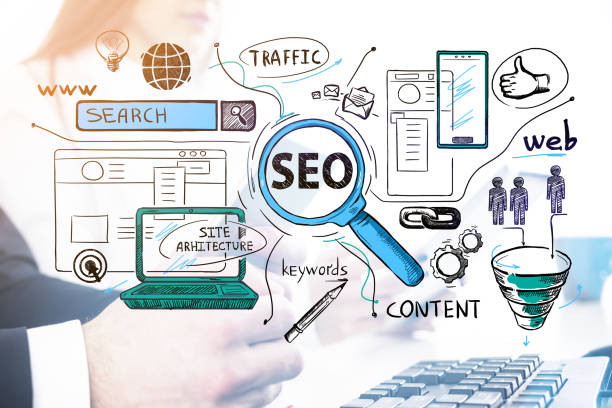
Keyword research is one of the most important steps in on-page SEO.
The purpose of this step is to find the words and phrases that users use to search for information related to your business.
These keywords should be relevant, popular, and have suitable competition.
To start keyword research, you can use various tools such as Google Keyword Planner, Ahrefs, SEMrush, and Keywordtool.io.
These tools help you find search volume, competition, and related keywords.
After finding suitable keywords, you should categorize them based on their importance and relevance to your business.
On-page SEO starts with keyword research.
You should also consider long-tail keywords.
These words are longer and more specific phrases that usually have less competition and can attract more targeted traffic to your site.
For example, instead of the keyword “sports shoes,” you can use the long-tail keyword “best sports shoes for running in Tehran.”
Finally, you should use keywords naturally in your site’s content.
Avoid excessive use of keywords (Keyword Stuffing), as this can cause your site to be penalized by Google.
On-page SEO improves with smart use of keywords.

Click here to preview your posts with PRO themes ››
Optimizing Page Title (Title Tag) and Meta Description
The page title (Title Tag) and meta description (Meta Description) are two important elements in on-page SEO that are displayed in search results.
The page title is the main title of your page, which is displayed at the top of the browser and in search results.
The meta description is a short summary of the page content that is displayed below the page title in the search results.
Optimizing these two elements can help you increase your click-through rate (CTR) in search results and attract more traffic to your site.
In the page title, you should use the main keyword of the page naturally.
The page title should be attractive, relevant, and unique.
Also, the length of the page title should not exceed 60 characters.
In the meta description, you should provide an attractive and informative summary of the page content.
The meta description should encourage the user to click on your site link.
Also, the length of the meta description should not exceed 160 characters.
Using keywords in the meta description can also help improve your site’s ranking in search results.
On-page SEO requires careful optimization of title and meta description tags.
Keep in mind that Google may automatically change the meta description, so try to provide the best and most relevant descriptions.
On-page SEO can make big changes by relying on these simple elements.
Below is a simple table for how to arrange keywords and the length of Title and Meta Description tags.
| Element | Description | Example |
|---|---|---|
| Title Tag | Page title, including the main and attractive keyword | Buy Original Sports Shoes | Online Store … |
| Meta Description | Concise and attractive description, including keywords and encouraging users to click | Types of original sports shoes at the best price and fast shipping. Easy purchase from online store … |
Content Optimization (Creating High-Quality and Relevant Content)
Content is king! This sentence is one of the most important principles of on-page SEO.
Google is looking for high-quality, relevant, and valuable content for users.
To optimize content, you need to produce content that answers users’ questions and needs.
Your content should be comprehensive, accurate, readable, and attractive.
Also, you should use keywords naturally in your content.
Avoid repeating keywords too much and try to use synonyms and related phrases as well.
Your content should have a proper structure.
Use headings (H1, H2, H3), subheadings, paragraphs, lists, and images to organize your content.
This makes your content more understandable for users and search engines.
Also, you should update your content regularly.
Old and outdated content can harm your site’s ranking.
On-page SEO is tied to great content.
Internal linking is another important aspect of content optimization.
By internally linking to related pages on your site, you can help users and search engines easily navigate your site and learn more.
On-page SEO can have a significant impact by producing useful content.
Are you tired of your online store not generating as much revenue as it could? Rasaweb, a specialist in designing professional online stores, solves this problem forever!
✅ Increase sales and revenue
✅ Fast loading speed and unparalleled user experience
⚡ Get a free online store design consultation
Image Optimization (File Name, Alt Text, and Image Size)
Images play an important role in the attractiveness and effectiveness of content.
But for images to also help your site’s SEO, you need to optimize them.
The first step is to choose the right file name for images.
The file name should be relevant to the image content and include the main keyword as well.
For example, instead of the file name “IMG_1234.jpg”, use the file name “buy-original-sports-shoes.jpg”.
Alt Text is the text that is displayed in place of the image if it fails to load.
Alt Text should be an accurate summary of the image content and include the main keyword as well.
Alt Text helps search engines understand the content of the image and display it in the search results.
Image size also matters.
Large images can slow down page loading speed.
Try to optimize your images before uploading and reduce their size.
On-page SEO also helps improve site speed by optimizing images.
Using appropriate image formats is also important.
JPEG and PNG formats are usually the best choice for web images.
On-page SEO can improve site ranking by doing these techniques.
URL Optimization (URL Structure and Keyword Usage)

Your site’s page addresses (URLs) are another important factor in on-page SEO.
URLs should be short, readable, and relevant to the page content.
Try to avoid long and complex URLs.
The URL should include the page’s main keyword.
For example, if your page is about “buying sports shoes”, your URL could be “example.com/buy-sports-shoes”.
Avoid using uppercase letters, spaces, and special characters in the URL.
Use a hyphen (-) instead of a space.
URLs should have a structured structure.
Use appropriate categories for your pages and organize URLs based on categories.
On-page SEO improves by creating a suitable structure for URLs.
Using SSL (HTTPS) is also important.
SSL is a security protocol that encrypts information between the user’s browser and the site’s server.
Google gives more points to sites that use SSL.
On-page SEO requires having optimized URLs.
Page Loading Speed (Site Speed Optimization)
Page loading speed is one of the most important factors in user experience and SEO.
Users expect site pages to load quickly.
If your page loads slowly, users will leave the site and go to other sites.
Google also gives more points to sites with high loading speed.
To optimize page loading speed, you can use various methods.
Compressing images, enabling browser caching, using CDN, reducing code volume, and using quality hosting are among these methods.
On-page SEO has a direct connection to site loading speed.
You can check your site’s speed using Google PageSpeed Insights and GTmetrix tools and identify and fix speed-related problems.
On-page SEO has a positive effect on Google rankings by improving site speed.
Below is a simple table for how to optimize page loading speed.
| Optimization Method | Description | Tools and Techniques |
|---|---|---|
| Image Optimization | Reduce image size without sacrificing quality | TinyPNG, ImageOptim, WebP format |
| Enable Browser Caching | Save static files in the user’s browser | htaccess, caching plugins |
| Use CDN | Distribute content on different servers around the world | Cloudflare, Akamai |
| Reduce Code Volume | Remove extra spaces and comments from codes | UglifyJS, CSSNano |
Internal Linking (Creating Links Between Related Pages)
Internal linking is one of the most important on-page SEO strategies.
Internal linking means creating links between different pages on your site.
This helps users and search engines easily navigate your site and learn more.
Internal linking helps search engines better understand your site’s structure and recognize the connections between different pages.
Also, internal linking helps distribute credit (Link Juice) between different pages on your site.
For internal linking, you should link to related pages on your site.
Use appropriate Anchor Text.
The link text should be relevant to the destination page content and include the main keyword as well.
Avoid linking to unrelated pages.
On-page SEO improves with internal linking of site pages.
Also, you should keep the number of internal links on each page balanced.
Avoid over-linking, as this can confuse users and search engines.
On-page SEO requires careful planning for internal linking.
Did you know that a weak company website takes away many opportunities from you every day? Solve this problem forever with professional corporate website design by Rasaweb!
✅ Create a powerful and reliable image of your brand
✅ Attract new targeted customers and increase sales
⚡ [Get a free website design consultation]
Site Responsiveness (Optimizing Site for Mobile Devices)
Today, most users use mobile devices to search for information.
Therefore, your site’s responsiveness (optimizing your site for mobile devices) is very important.
A responsive site automatically adjusts its size and layout based on the user’s device screen size.
Google gives more points to responsive sites.
If your site is not responsive, your site’s ranking in search results may decrease.
To make sure your site is responsive, you can use Google’s Mobile-Friendly Test tool.
This tool shows you how your site appears on mobile devices and what problems it has.
On-page SEO has a direct connection to site responsiveness.
To create a responsive site, you can use CSS frameworks like Bootstrap.
Also, you should optimize your images for mobile devices and use readable fonts.
On-page SEO can be effective in Google rankings by having a responsive site.
Sitemap and robots.txt file
The Sitemap and robots.txt file are two important files that help search engines better understand and index your site.
A Sitemap is a list of all the important pages on your site.
By providing a Sitemap to Google, you help Google find all the pages on your site and display them in search results.
The robots.txt file is a file that tells search engines which pages on your site they should not index.
For example, you can use the robots.txt file to prevent indexing of admin pages, shopping cart pages, and other unnecessary pages.
On-page SEO can help Google in identifying and indexing site pages by using a sitemap and robots.txt file.
You can create your sitemap using online tools and register it in Google Search Console.
Also, you should create your robots.txt file carefully and make sure that you have not blocked any important pages from being indexed.
On-page SEO can improve site ranking by having these two important files.
Frequently Asked Questions
| Number | Question | Answer |
|---|---|---|
| 1 | What is On-Page SEO? | On-page SEO refers to the set of actions that are performed within a website and to optimize its pages in order to achieve a better ranking in search results. |
| 2 | What is the most important factor in on-page SEO? | High-quality, relevant and comprehensive content that meets the user’s needs is the most important factor in on-page SEO. |
| 3 | What role does the Title Tag play in on-page SEO? | The title tag is one of the most important factors that tells search engines and users what the content of the page is about. It should include the main keyword and be attractive. |
| 4 | How important is the Meta Description tag? | Although it does not directly affect ranking, it is very effective on click-through rate (CTR) in search results and encourages users to visit the page. |
| 5 | How is image optimization done in on-page SEO? | By using a suitable alt tag, compressing the image size to increase loading speed, and naming the image file meaningfully. |
| 6 | What is the importance of using headings (H1, H2, H3) in on-page SEO? | Headings help structure content, increase readability, and help search engines understand the hierarchy and sub-topics of the content. |
| 7 | What does Internal Linking mean and what are its benefits? | Internal linking means creating links between different pages of a website. This helps to distribute credit, improve user navigation, and help search engines crawl. |
| 8 | Where should the main keyword (Focus Keyword) be placed on the page? | The main keyword should be in the title tag, meta description, H1, first paragraph, and naturally throughout the text and, if possible, in the URL address. |
| 9 | What effect does copied or duplicate content have on on-page SEO? | Duplicate content can damage the site’s ranking and confuse search engines as to which is the original version and may be detected as spam. |
| 10 | How important is page loading speed in on-page SEO? | Page loading speed is an important ranking factor and directly affects user experience. Slow pages increase user bounce rates. |
And other services of Rasa Web advertising agency in the field of advertising
Intelligent brand identity: Professional optimization to increase site visits by customizing the user experience.
Intelligent Sales Automation: A creative platform to improve sales by optimizing key pages.
Intelligent Marketing Automation: A professional solution to increase site visits by focusing on customizing the user experience.
Intelligent Custom Software: Transform digital branding with the help of attractive UI design.
Intelligent SEO: An effective tool to manage campaigns with the help of SEO-driven content strategy.
And more than hundreds of other services in the field of internet advertising, advertising consulting and organizational solutions
Internet Advertising | Advertising Strategy | Advertorial
Sources
On-page SEO optimization
,On-page SEO tutorial
,Complete guide to on-page SEO
,What is On-Page SEO?
? Are you ready to grow your business in the digital world? Rasaweb Digital Marketing Agency paves the way for your success by offering comprehensive and innovative solutions, including website design with a modern user interface and targeted marketing strategies.
📍 Tehran, Mirdamad Street, next to Central Bank, South Kazerun Alley, Ramin Alley No. 6