
What is On-Page SEO and Why Does It Matter?

#On-Page SEO refers to the set of actions you take within your website to improve its ranking in Google and other search engine results.
These actions include optimizing content, site structure, title tags, meta descriptions, images, and other factors related to your website.
On-Page SEO is one of the main pillars of website optimization, and without it, your off-page SEO efforts alone will not be sufficient.
The importance of On-Page SEO lies in the fact that it helps search engines better understand your website’s content and display it to users who are looking for relevant information.
By performing correct On-Page SEO, you can increase your site’s organic traffic, improve your site’s ranking in search results, and ultimately increase your sales and revenue.
On-Page SEO also improves the user experience because your site’s content will be easier for users to understand and access.
Wikipedia provides more information on this topic.
In short, On-Page SEO is an essential investment for any business that wants to succeed in the online world.
By spending time and effort optimizing your website, you can be sure that your site is exposed to your target audience and you will achieve your business goals.
On-Page SEO is an ongoing process and you should regularly review and optimize your website to keep up with the latest changes to search engine algorithms.
By continuously performing on-page SEO, you can help increase your site’s organic traffic.
Are you tired of losing customers due to poor e-commerce website design? With Rasaweb, solve this problem forever!
✅ Increase sales and visitor-to-customer conversion rates
✅ Smooth and attractive user experience for your customers⚡ Get free consultation
Keyword Research and Finding the Best Ones for On-Page SEO
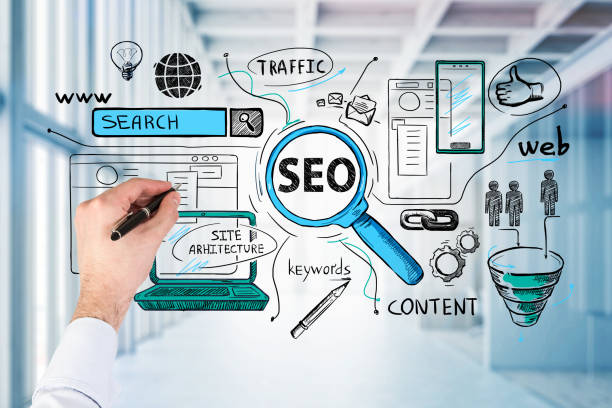
Keyword research is the cornerstone of any successful On-Page SEO strategy.
First of all, you need to know what phrases your target audience types into search engines to look for your products or services.
There are various tools for keyword research, including Google Keyword Planner, Ahrefs, SEMrush, and Moz Keyword Explorer.
These tools help you find search volume, competition, and related keywords.

Click here to preview your posts with PRO themes ››
When choosing keywords, look for a combination of head keywords and long-tail keywords.
Head keywords usually have a higher search volume, but the competition for them is also higher.
Long-tail keywords are more specific phrases that have lower search volume, but are more targeted and have a better chance of ranking.
In this area, you can also use Moz’s specialized articles.
Also, pay attention to search intent.
What are users looking for when they search? Are they looking for information, to buy a product, or to find a specific service? Optimize your content based on user intent to provide a better user experience and increase your chances of ranking.
After keyword research, you can choose the best options using keyword analysis.
On-Page SEO is heavily dependent on relevant and high-search keywords.
By using keywords appropriately, you can improve your site’s ranking.
On-Page SEO is not limited to the use of keywords, but also includes optimizing the site structure and content.
Optimizing Title Tags and Meta Descriptions
Title tags and meta descriptions are the first things users see in search results.
These two elements play an important role in attracting users to your website.
The title tag is the title of your page and should be attractive, relevant, and contain the main keyword.
The meta description is a summary of the content of your page and should encourage the user to click on your link.
The best length for a title tag is about 50-60 characters, and the best length for a meta description is about 150-160 characters.
Make sure your title tags and meta descriptions are unique and optimized for each page of your website.
Use relevant keywords in your title tags and meta descriptions, but avoid overdoing it.
Your goal is to provide useful and engaging information to users, not to deceive search engines.
For more information on these tags, you can refer to Yoast SEO articles.
On-Page SEO is highly dependent on optimizing these tags.
Click here to preview your posts with PRO themes ››
Here is a sample table with CSS styling to show the importance of optimizing title tags and meta descriptions:
| Element | Description | Importance in SEO |
|---|---|---|
| Title Tag | The title of the page that is displayed in search results. | Very high – click determinant |
| Meta Description | A summary of the content of the page that appears below the title in search results. | High – Click Incentive |
This table shows how important title tags and meta descriptions are to the SEO of the site.
On-Page SEO means optimizing all these elements correctly.
Optimizing Website Content for Search Engines and Users
Content is the king of SEO.
Without high-quality, engaging, and relevant content, you can’t rank well in search results.
Your content should provide users with useful information and answer their questions.
Also, your content should be updated regularly to be attractive to search engines.
On-Page SEO depends on producing valuable content.
When producing content, pay attention to your keywords and use them naturally in your text.
Use head keywords and long-tail keywords in a balanced way.
Also, use images, videos, and other visual elements to make your content more engaging.
Make sure your images are optimized and have alt text.
On-Page SEO is best implemented with high-quality and optimized content.
Design the structure of your content in a way that is easier for users to understand.
Use headings, subheadings, paragraphs, and lists to organize your content.
Also, use internal links to connect different pages of your website.
On-Page SEO also includes internal linking to relevant pages of the site.
Are you annoyed by losing customers who have visited your site to make a purchase?
Rasaweb is your specialized solution for having a successful online store.
✅ Significantly increase your online sales
✅ Creating trust and professional branding with customers⚡ Get free advice from Rasaweb experts!
Optimizing Images for On-Page SEO
Images play an important role in the attractiveness and user experience of your website.
However, if your images are not optimized, they can slow down your site’s loading speed and negatively affect your SEO.
Optimizing images for On-Page SEO involves several steps:
- Choosing the right format: Use JPEG, PNG, or WebP formats for your images.
JPEG is suitable for images with many colors, PNG is suitable for images with graphics and text, and WebP is a newer format that has both good quality and a smaller size. - Reduce image size: Use image compression tools to reduce the size of your images.
This will make your images load faster. - Use Alt Text: Write a descriptive alt text for each image.
Alt text helps search engines understand the content of the image and is also displayed to users if the image does not load. - Naming image files: Name your image files with descriptive names containing keywords.
By optimizing your images, you can improve your site’s loading speed, improve the user experience, and increase your chances of ranking in search results.
On-Page SEO will perform better by optimizing images.
On-Page SEO is more than just text, and images also play an important role.
Improving Site Loading Speed and Its Impact on SEO

Site loading speed is one of the most important ranking factors in Google.
Users expect websites to load quickly, and if your site is slow, they will quickly leave it.
This increases the bounce rate and lowers your ranking in search results.
On-Page SEO helps improve ranking by increasing site speed.
To improve your site’s loading speed, you can take the following steps:
- Optimize images: Large images are one of the main factors that slow down site loading speed.
Compress your images and use appropriate formats. - Use a CDN: Use a Content Delivery Network (CDN) to distribute your site’s content across different servers.
This allows users to receive your site’s content from the server closest to them, increasing your site’s loading speed. - Enable caching: By enabling caching, you can store static versions of your site’s pages and display them to users faster.
- Optimize code: Optimize your site’s code and avoid unnecessary code.
- Choose suitable hosting: Use a reputable and high-quality hosting company.
By improving your site’s loading speed, you can improve the user experience, reduce the bounce rate, and increase your ranking in search results.
On-Page SEO places special emphasis on site loading speed.
On-Page SEO ultimately leads to an improved user experience.
Internal Linking and Its Importance in On-Page SEO

Internal linking is one of the most important On-Page SEO techniques.
Internal links help search engines better understand your site structure and also help users navigate your site easily.
Internal linking increases the credibility of your site’s pages and improves their ranking in search results.
Internal linking shows search engines which pages are important to you.
When internal linking, pay attention to the following points:
- Use appropriate anchor text: Anchor text is the text you click on to go to another page.
Use descriptive anchor text that is relevant to the destination page. - Link to important pages of your site: Link to pages that you want to improve their ranking.
- Use relevant links: Link to pages whose content is relevant to the current page.
- Avoid broken links: Broken links have a negative impact on your SEO.
Regularly check your site and fix broken links.
With correct internal linking, you can improve your site structure, improve the user experience, and increase your ranking in search results.
On-Page SEO achieves better results with proper internal linking.
On-Page SEO includes all aspects of on-site optimization.
Here is a sample table with CSS styling to show the importance of internal linking:
| Advantage | Description |
|---|---|
| Improve Ranking | Internal linking helps search engines better understand the site structure and identify important pages. |
| Improve User Experience | Internal linking helps users easily navigate the site and find the information they need. |
| Increase Dwell Time | With internal linking, users stay longer on your site and view more pages. |
This table shows what benefits internal linking has for site SEO.
On-Page SEO helps improve ranking and user experience by using internal links.
Optimizing URLs for SEO
URLs (Internet addresses) play an important role in SEO.
Optimized URLs help search engines better understand the content of the page and also help users easily remember and share the page.
On-Page SEO also includes optimizing URLs.
When creating URLs, pay attention to the following points:
- Use keywords: URLs should contain keywords related to the content of the page.
- Use short URLs: Short URLs are easier to read and remember.
- Use hyphens (-) instead of underscores (_): Search engines consider hyphens as word separators, while ignoring underscores.
- Use lowercase letters: URLs should be written in lowercase letters.
- Use descriptive URLs: URLs should briefly describe the content of the page.
By optimizing URLs, you can help search engines better understand the content of the page and also improve the user experience.
On-Page SEO delivers better results with optimized URLs.
On-Page SEO pays attention to all site details.
Are you disappointed with the low conversion rate of your online store?
Rasaweb is your definite solution with professional e-commerce website design!
✅ Increase your sales and revenue
✅ A unique user experience for your customers
⚡ Get a free consultation now!
Using Structured Data (Schema Markup)

Structured data (Schema Markup) are codes that help search engines better understand the content of your page.
Using structured data, you can clearly provide information about your business, products, events, and other items to search engines.
This makes your site look more prominent and attractive in search results.
On-Page SEO helps search engines by using Schema.
There are different types of structured data that you can use.
Some of the most common types of structured data include:
- Organization: For information about your business
- Product: For information about your products
- Event: For information about your events
- Article: For information about your articles
- Recipe: For information about your cooking recipes
To add structured data to your site, you can use various tools such as Google’s Structured Data Markup Helper.
On-Page SEO helps improve the display of the site in search results by adding structured data.
On-Page SEO means making our site more understandable for search engines.
Schema markup helps search engines better understand your site’s content.
Analyzing and Monitoring On-Page SEO Results

On-Page SEO is an ongoing process and you should regularly analyze and monitor your results.
Using tools like Google Analytics and Google Search Console, you can monitor your site’s traffic, identify the keywords you’re ranking with, and fix technical issues on your site.
By analyzing and monitoring the results of On-Page SEO, you can identify the strengths and weaknesses of your strategy and make the necessary changes based on them.
You can also use this information to improve your site’s content, optimize keywords, and internal linking.
On-Page SEO will be incomplete without analysis and monitoring.
Remember that On-Page SEO is a time-consuming process and the results will gradually appear.
With patience and perseverance, you can improve your site’s ranking in search results and increase your organic traffic.
On-Page SEO is a long-term investment that will ultimately benefit you.
You can use Google Search Console in this area.
Frequently Asked Questions
| Number | Question | Answer |
|---|---|---|
| 1 | What is On-Page SEO? | On-page SEO refers to the set of actions that are performed within a website and to optimize its pages in order to achieve a better ranking in search results. |
| 2 | What is the most important factor in on-page SEO? | High-quality, relevant and comprehensive content that meets the user’s needs is the most important factor in on-page SEO. |
| 3 | What role does the title tag play in on-page SEO? | The title tag is one of the most important factors that tells search engines and users what the page content is about. It should include the main keyword and be attractive. |
| 4 | How important is the meta description tag? | Although it does not directly affect ranking, it is very effective on the click-through rate (CTR) in search results and encourages users to visit the page. |
| 5 | How is image optimization done in on-page SEO? | By using a suitable alt tag, compressing the image size to increase loading speed, and meaningfully naming the image file. |
| 6 | What is the importance of using headings (H1, H2, H3) in on-page SEO? | Headings help structure content, increase readability, and help search engines understand the hierarchy and subtopics of the content. |
| 7 | What does internal linking mean and what are its benefits? | Internal linking means creating links between different pages of a website. This helps distribute credit, improve user navigation, and helps search engine crawling. |
| 8 | Where on the page should the focus keyword be placed? | The main keyword should be in the title tag, meta description, H1, first paragraph, and naturally throughout the text and, if possible, in the URL address. |
| 9 | What effect does duplicate or copied content have on on-page SEO? | Duplicate content can harm the site’s ranking and confuse search engines as to which is the original version, and may detect it as spam. |
| 10 | How important is page loading speed in on-page SEO? | Page loading speed is an important ranking factor and directly affects the user experience. Slow pages increase the bounce rate of users. |
And other services of Rasa Web advertising agency in the field of advertising
Intelligent Content Strategy: A new service to increase campaign management by optimizing key pages.
Intelligent Marketing Automation: A professional solution for online growth with a focus on custom programming.
Intelligent Direct Marketing: Designed for businesses looking to digitally brand through a SEO-driven content strategy.
Intelligent UI/UX: A creative platform to improve campaign management with accurate audience targeting.
Intelligent Sales Automation: Designed for businesses looking to analyze customer behavior through an SEO-driven content strategy.
And more than hundreds of other services in the field of Internet advertising, advertising consulting and organizational solutions
Internet advertising | Advertising strategy | Advertorial
Sources
Introduction to SEO: What is SEO and how does it work?
,On-page SEO optimization; Step by step and principled
,What is On-Page SEO and Why is it Important?
,On-Page SEO Training in a Practical and Complete Way
? Ready to transform your business in the digital world? Rasaweb Digital Marketing Agency, with expertise in responsive website design, SEO optimization and professional social network management, helps you on the path to growth and achieving big goals.
📍 Tehran, Mirdamad Street, next to the Central Bank, Southern Kazerun Alley, Ramin Alley No. 6
“`