
What is On-Page SEO and Why Does It Matter?
#On_Page_SEO (On-Page SEO) refers to the set of actions taken to optimize website pages from within in order to improve the site’s ranking in search results of #Google and other search engines.
These actions include optimizing content, using appropriate keywords, improving page structure, and increasing site loading speed.
On-page SEO is important because it helps search engines better understand the site’s content and display it to relevant users.
By optimizing on-page SEO, you can increase the site’s organic traffic and, as a result, achieve your business goals.
The importance of **on-page SEO** is that you have complete control over it.
Unlike #Off_Page_SEO (Off-Page SEO), which includes link building and activities outside the site, on-page SEO is completely under your control, and you can make significant improvements to your site’s ranking by making appropriate changes.
For example, by choosing the right keywords and using them in titles, meta descriptions, and page text, you can show search engines that your page is relevant to users’ searches.
On-page SEO is an essential part of a successful #SEO strategy and should not be ignored.
On-page SEO is a vital aspect of SEO that affects your website’s visibility and ranking in search engine results pages (SERPs).
Understanding and implementing effective on-page SEO strategies is essential for attracting organic traffic and achieving online success.
Worried about losing customers because you don’t have a professional online store?
Forget these worries with online store design by Rasaweb!
✅ Significant increase in sales and visitor-to-customer conversion rate
✅ Professional and user-friendly design that earns customer trust
⚡ Get free consultation from Rasaweb
Keyword Research; The Foundation of On-Page SEO

Keyword research is one of the most important steps in on-page SEO.
Choosing the right keywords helps you optimize your content based on users’ needs and searches.
To get started, make a list of keywords related to your field of activity.
Use keyword research tools such as Ahrefs Keywords Explorer and Keywordtool.io to find keywords with high search volume and low competition.
Also, look for Long-Tail Keywords that are more precise and targeted.

Click here to preview your posts with PRO themes ››
After finding the right keywords, use them in titles, subtitles, meta descriptions, page text, and image tags.
Note that excessive use of keywords (Keyword Stuffing) can harm your site’s SEO.
Try to use keywords naturally and in the appropriate text.
Using keywords correctly and strategically helps search engines better understand your content and display it to relevant users.
On-page SEO by following these principles makes your website visible in search results.
Optimizing Titles and Meta Descriptions

Title Tags and Meta Descriptions are the first things users see in search results.
Titles should be attractive, concise, and include the main keyword.
Titles should not be longer than 60 characters to be fully displayed in search results.
Meta descriptions should provide a summary of the page’s content and encourage users to click.
Meta descriptions should not be longer than 160 characters.
Optimizing titles and meta descriptions helps search engines better understand the content of your pages and display it to relevant users.
Also, titles and meta descriptions can increase the click-through rate (CTR) of your pages, which helps improve your site’s ranking in search results.
Use search result preview tools to check the appearance of titles and meta descriptions in search results and optimize them as needed.
On-page SEO relies on these things to lead you to success.
One of the important principles in #On_Page_SEO is to choose attractive titles.
This encourages the audience to click.
| Element | Description | Best Practices |
|---|---|---|
| Page Title (Title Tag) | The page title displayed in search results. | Attractive, includes the keyword, less than 60 characters. |
| Meta Description | Summary of the page content displayed in search results. | Useful, attractive, persuasive summary, less than 160 characters. |
Optimizing Page Content
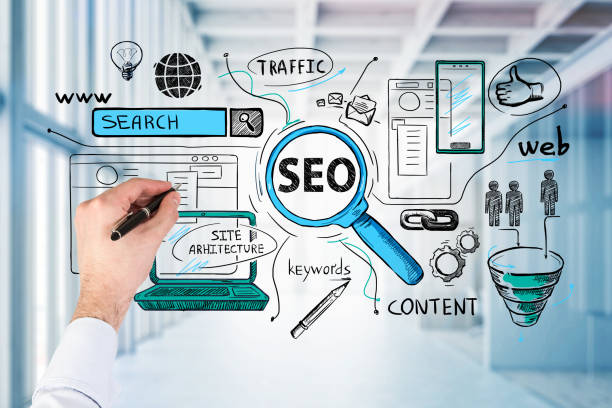
Quality and relevant content is one of the main factors in #On_Page_SEO.
Your content should be valuable to users and answer their questions and needs.
Use appropriate keywords in the text, but avoid overusing them.
Update your content regularly and use relevant images and videos.
Longer content usually ranks better than shorter content, but content length should not come at the expense of quality.
To optimize page content, use the appropriate structure.
Use titles and subtitles to divide content and use short, readable paragraphs.
Use lists and bullets to present information in an organized manner.
Also, pay attention to content readability and use appropriate fonts and colors.
Your content should be optimized for both users and search engines.
In #On_Page_SEO, great importance is given to the quality of the content.
Tired of losing business opportunities due to the lack of a professional corporate website? Don’t worry anymore! With Rasaweb’s corporate website design services:
✅ Your brand’s credibility and professionalism will increase.
✅ You will attract more customers and sales leads.
⚡ Get a free consultation now to get started!
Optimizing Images

Images can play an important role in the attractiveness and improvement of your site’s SEO.
To optimize images, use the appropriate file name and use the Alt Text tag to describe the image.
The alt tag helps search engines understand the content of the image and display it to relevant users.
Optimize the size of images to increase your site’s loading speed.
Use appropriate formats such as JPEG and PNG.
High-quality and relevant images can increase user engagement and help improve your site’s ranking in search results.
Use unique and original images and avoid using duplicate and low-quality images.
Check and update your images regularly.
In #On_Page_SEO, images play a significant role.
Optimizing URL Structure

The URL structure of your site’s pages should be simple, readable, and include the keyword.
Avoid long and complex URLs and use lowercase letters and hyphens (-) to separate words.
A proper URL structure helps search engines better understand the content of your pages and display it to relevant users.
Also, a proper URL structure can help improve user experience (UX).
The best way to optimize URL structure is to use logical and hierarchical categories.
For example, if your site has different sections, use subdirectory URLs to organize pages.
Avoid changing page URLs after publishing, as this can harm your site’s ranking.
If you have to change the URL, use a 301 redirect to redirect users and search engines to the new URL.
The appropriate URL is one of the principles of on-page SEO.
Site Loading Speed and On-Page SEO

Site loading speed is one of the important factors in user experience and #SEO.
Users expect website pages to load quickly, and if your site’s loading speed is slow, users may leave your site.
Slow loading speed can lead to an increase in bounce rate and a decrease in the amount of time users spend on your site, which helps reduce your site’s ranking in search results.
To increase your site’s loading speed, optimize images, use caching, use a content delivery network (CDN), and optimize your HTML and CSS code.
Use site speed test tools such as Google PageSpeed Insights to identify your site’s speed problems and fix them.
High loading speed is one of the main principles of #On_Page_SEO.
| Factor | Description | Optimization Solution |
|---|---|---|
| Image Size | Large images slow down loading speed. | Optimize size and compress images. |
| Caching | Storing information for faster access. | Enable browser and server caching. |
| Content Delivery Network (CDN) | Distribute content across different servers for faster access. | Use a CDN to distribute images and files. |
| HTML and CSS Code | Disorganized and bulky code slows down speed. | Optimize and compress code. |
Internal Links; Easy Navigation and SEO

Internal Links are links that point from one page of your site to another page of your site.
Internal links help users easily navigate your site and find the information they need.
Also, internal links help search engines better understand your site’s structure and identify important pages on your site.
To use internal links, use appropriate Anchor Text and use relevant keywords in the link text.
Place internal links strategically in your content and avoid linking to unrelated pages.
Internal links should help improve user experience and your site’s SEO.
Internal linking is one of the important principles of #On_Page_SEO.
In #On_Page_SEO, internal links play an important role and Google pays special attention to them.
Are you losing business opportunities because of an outdated website? With Rasaweb, solve the problem of not attracting potential customers through the website forever!
✅ Attract more high-quality leads
✅ Increase brand credibility in the eyes of customers
⚡ Get a free corporate website design consultation
Responsive Optimization and Mobile Compatibility

Given the increasing use of mobile phones, Responsive optimization and Mobile-Friendly compatibility are important factors in #SEO.
Your site should display correctly on all devices and screen sizes.
Responsive design shows search engines that your site is optimized for mobile users, which can help improve your site’s ranking in search results.
To optimize for responsiveness, use a responsive template, optimize images and videos, and use the Google Mobile-Friendly Test for mobile compatibility testing.
Your site should be easy to use on mobile phones and users should be able to access all the information they need.
Mobile optimization is an essential aspect of #On_Page_SEO.
Continuous Review and Improvement of On-Page SEO

#SEO is a continuous process and should not be abandoned after performing initial optimizations.
Regularly review your site’s performance and identify its strengths and weaknesses.
Use web analytics tools such as Google Analytics to review site traffic, bounce rate, user retention time, and other important metrics.
Given the changes in search engine algorithms, you need to constantly update your SEO strategy and use new and effective methods.
By continuously reviewing and improving on-page SEO, you can improve your site’s ranking in search results and increase your site’s organic traffic.
On-page SEO requires continuous review and improvement and should not be neglected.
On-page SEO achieves results with continuous effort.
Frequently Asked Questions
| Question | Answer |
|---|---|
| What is On-page SEO? | On-page SEO refers to the set of actions taken inside a website and on the content of pages to achieve a better ranking in search results. |
| Why is on-page SEO important for a website? | On-page SEO helps search engines better understand your page’s content and assess its importance. It also provides a better user experience for visitors. |
| What are the most important on-page SEO factors? | The most important factors include keyword optimization, content quality, Title Tag, Meta Description, URL structure, heading tags (H1-H6), internal linking, and image optimization. |
| What role does the Title Tag play in on-page SEO? | The Title Tag is one of the most important on-page SEO factors, which displays your page’s title in search results and the browser tab. It should include the main keyword and be attractive. |
| What is the importance of Meta Description in on-page SEO? | The Meta Description provides a summary of the page’s content and, although it does not directly affect ranking, it can increase the click-through rate (CTR) by encouraging users to click. |
| How is the keyword used in on-page SEO? | Keywords are phrases that users use to search for information in search engines. Appropriate and natural use of them in the content helps the search engine to identify the subject of the page. |
| What is internal linking and what is its benefit in on-page SEO? | Internal linking means creating links between different pages of a website. This helps to distribute the credit of pages, helps search engine robots crawl and improves the user experience. |
| How does image optimization affect on-page SEO? | Image optimization includes volume compression, using a suitable Alt tag, and proper naming of files. This improves the page loading speed and helps search engines understand the content of the image. |
| What does quality content mean in on-page SEO? | Quality content means content that is comprehensive, accurate, unique, up-to-date and user-friendly and meets the needs of users. |
| What role does the URL structure play in on-page SEO? | Readable, short URLs including the main keyword help search engines and users to have a better understanding of the page content and improve the user experience. |
and other services of Rasa Web Advertising Agency in the field of advertising
Smart data analysis: A fast and efficient solution for digital branding with a focus on attractive user interface design.
Smart Marketplace: A professional solution for digital branding with a focus on smart data analysis.
Smart Social Media: Transform your click-through rate with the help of marketing automation.
Smart Conversion Rate Optimization: A professional solution for attracting customers with a focus on accurate audience targeting.
Smart Reportage: A creative platform for improving online growth with smart data analysis.
And more than hundreds of other services in the field of internet advertising, advertising consulting and organizational solutions
Internet advertising | Advertising strategy | Advertisement reportage
Resources
On-Page Optimization on Moz
,Ahrefs On-Page SEO Guide
,On-Page SEO: The Complete SEO Guide in SEMrush
,On-Page SEO: The Ultimate Optimization Guide
“`html
? With Afarin Rasaweb Digital Marketing Agency, transform your business in the online world; From fast website design to comprehensive SEO strategies.
“`
📍 Tehran, Mirdamad Street, next to the Central Bank, South Kazerun Alley, Ramin Alley No. 6