What is an Artificial Intelligence Robot and What are its Uses?
In today’s world, the term #Artificial_Intelligence_Robot is heard more and more often.
But what is an Artificial Intelligence Robot really? In simple terms, an AI robot is a computer program designed to perform tasks that typically require human intelligence.
These tasks can include learning, problem-solving, decision-making, understanding natural language, and pattern recognition.
The AI robot uses complex algorithms such as machine learning and neural networks to process data and perform these tasks.
The applications of Artificial Intelligence Robots are very broad and diverse.
Some of the most important applications include:
- Customer Service: AI robots can act as virtual assistants on websites and messaging apps to answer customer questions and provide 24-hour support.
- Healthcare: AI robots can assist doctors in diagnosing diseases, planning treatments, and monitoring patients.
- Finance: AI robots can be used to analyze financial data, identify fraud, and provide investment advice.
- Manufacturing: AI robots can be used to automate manufacturing processes, control quality, and optimize the supply chain.
- Education: AI robots can be used as private tutors and teaching assistants to provide personalized learning and support to students.
In short, an Artificial Intelligence Robot is a powerful tool that can help improve efficiency, reduce costs, and increase productivity in various fields.
Artificial Intelligence is progressing day by day and is expected to play a more important role in our lives in the future.
Is your current online store design causing you to lose customers and sales?
Rasaweb is your solution with modern and user-friendly online store designs!
✅ Dramatic increase in conversion rates and sales
✅ Creating a strong brand and gaining customer trust
⚡ Get free online store design consultation from Rasaweb!
Types of Artificial Intelligence Robots and the Features of Each

Artificial Intelligence robots are divided into different types based on their capabilities and how they function.
Understanding these classifications helps us to better understand the capabilities and limitations of each type of AI robot.
1.
Reactive AI Robots: This type of AI robot is the simplest type and only reacts based on current inputs.
They have no memory and cannot learn from their past experiences.
A famous example of this type of robot is Deep Blue, the computer that defeated Garry Kasparov in chess.
Deep Blue only made decisions based on the current position of the pieces on the board and had no understanding of long-term strategies.
2.
Limited Memory AI Robots: These types of robots can store a limited amount of information about the past.
This information can be used to improve future decision-making.
For example, a self-driving car could use its limited memory to store information about previous routes, obstacles, and weather conditions to drive more safely.
3.
Theory of Mind AI Robots: These types of robots are able to understand the thoughts, feelings, and motivations of others.
They can predict how others will behave and make decisions based on that.
This type of robot is still in the early stages of development, but has great potential for application in areas such as social interactions and negotiations.
4.
Self-Aware AI Robots: These types of robots are self-aware and know that they are independent entities.
They can think about themselves and have their own goals and values.
This type of robot is still in the realm of science fiction and does not currently exist.
Choosing the right type of AI robot depends on the intended applications and the amount of complexity required.
As technology advances, we expect to see the development of more advanced AI robots with more capabilities.
AI robots are currently used in many industries and are expected to play a more important role in our lives in the future.
How does an Artificial Intelligence Robot Work?

The operation of an AI robot is based on several key components that work together to perform the desired tasks.
Understanding these components helps us to better understand how these systems work.
1.
Data: AI robots need data to learn and perform tasks.
This data can include images, text, sound, video, or any other type of information.
The volume and quality of data have a significant impact on the performance of the AI robot.
The more data there is and the higher the quality, the better the AI robot can learn and the more accurately it can perform.
2.
Algorithms: Algorithms are a set of instructions that tell the AI robot how to process data and make decisions.
Different algorithms exist for different tasks.
For example, machine learning algorithms are used to learn from data, while natural language processing algorithms are used to understand and generate human language.
3.
Machine Learning: Machine learning is a key technique in AI robots that allows them to learn from data without being explicitly programmed.
There are different types of machine learning, including supervised learning, unsupervised learning, and reinforcement learning.
4.
Natural Language Processing: Natural Language Processing allows AI robots to understand and generate human language.
This technology is used for applications such as language translation, text summarization, and question answering.
5.
Hardware: AI robots need hardware to run algorithms and process data.
The required hardware depends on the complexity of the tasks and the volume of data.
Some AI robots can run on regular computers, while others require specialized hardware such as GPUs.

Click here to preview your posts with PRO themes ››
In short, an AI robot works by using data, algorithms, machine learning, natural language processing, and hardware to perform the desired tasks.
These components interact to create an intelligent system that is capable of learning, problem-solving, and decision-making.
AI robots are developing rapidly and are expected to play a more important role in our lives in the future.
| Feature | Description |
|---|---|
| Data | Information needed for learning and performing tasks |
| Algorithms | Instructions for processing data and making decisions |
| Machine Learning | A technique for learning from data without explicit programming |
| Natural Language Processing | Understanding and generating human language |
| Hardware | Running algorithms and processing data |
Advantages and Disadvantages of Using Artificial Intelligence Robots
The use of AI robots has its own advantages and disadvantages.
Understanding these advantages and disadvantages helps us to make better decisions about using this technology.
Advantages:
- Increased Efficiency: AI robots can perform tasks faster and more accurately than humans.
- Cost Reduction: AI robots can reduce labor and operating costs.
- Improved Accuracy: AI robots can reduce human errors.
- 24-Hour Availability: AI robots can work continuously and without interruption.
- Scalability: AI robots can be easily scaled to meet changing needs.
Disadvantages:
- Implementation Costs: Implementing AI robots can be expensive.
- Complexity: Developing and maintaining AI robots can be complex.
- Lack of Expertise: There is a shortage of skilled professionals in the field of artificial intelligence.
- Ethical Issues: The use of AI robots can raise ethical issues.
- Impact on Employment: AI robots can lead to job losses.
In general, the advantages of using AI robots outweigh their disadvantages.
However, it is important to consider the disadvantages before implementing this technology and plan to reduce them.
AI robots can help improve efficiency, reduce costs, and increase productivity, but they should be used carefully and responsibly.
AI robots have great potential to change the world, but they must be used responsibly.
Research shows that 80% of customers trust companies with professional websites more. Does your current website inspire this trust?
With Rasaweb’s corporate website design services, solve the problem of customer distrust and a weak online image forever!
✅ Create a professional image and increase customer trust
✅ Attract more sales leads and grow your business
⚡ Get free consultation
Challenges Facing the Development of Artificial Intelligence Robots
The development of AI robots faces many challenges that require attention and appropriate solutions.
These challenges can be technical, ethical, social, and economic.
1.
Lack of Data: AI robots need a lot of data to learn and improve performance.
Collecting and labeling this data can be time-consuming and expensive.
Also, access to sensitive and confidential data may be subject to limitations.
2.
Ethical Issues: The use of AI robots can raise ethical issues.
For example, if a self-driving car causes an accident, who will be responsible? Or if an AI robot is used for facial recognition, how can its misuse be prevented?
3.
Lack of Expertise: Developing and maintaining AI robots requires skilled professionals in various fields such as machine learning, natural language processing, and computer science.
The shortage of these experts can hinder the development of AI robots.
4.
Security Issues: AI robots can be vulnerable to cyber attacks.
If an AI robot is hacked, it can be used for malicious purposes.
Therefore, ensuring the security of AI robots is very important.
5.
Impact on Employment: AI robots can lead to job losses.
This can lead to social and economic dissatisfaction.
Therefore, plans should be made to manage the impact of AI robots on employment.
AI robots are currently used in various industries.
In general, the development of AI robots faces many challenges that require cooperation between government, industry, and academia.
By solving these challenges, the benefits of this technology can be fully realized.
The proper use of AI robots can solve many problems.
What will be the Future of Artificial Intelligence Robots?
The future of AI robots is very bright and promising.
As technology advances, AI robots are expected to become more advanced, more powerful, and more versatile.
They can play a more important role in various areas of our lives.
1.
Increased Automation: AI robots can automate many repetitive and tedious tasks.
This can help humans focus on more creative and important tasks.
2.
Improved Health: AI robots can assist doctors in diagnosing diseases, planning treatments, and monitoring patients.
They can also be used to develop new drugs and innovative treatments.
AI robots can greatly assist doctors.
3.
Increased Productivity: AI robots can help companies increase productivity, reduce costs, and improve quality.
They can be used to automate manufacturing processes, manage the supply chain, and provide customer service.
4.
Personalized Learning: AI robots can be used as private tutors and teaching assistants to provide personalized learning and support to students.
They can help students learn at their own pace and achieve their educational goals.
AI robots can provide significant help to students.
5.
Smart Cities: AI robots can be used to manage traffic, reduce air pollution, improve security, and provide better services to citizens.
They can help create smarter and more sustainable cities.
The proper use of AI robots can create a big transformation.

Click here to preview your posts with PRO themes ››
In general, the future of AI robots is full of new opportunities.
By developing and using this technology responsibly, we can create a better world for ourselves and future generations.
AI robots will definitely play an important role in the future.
Introducing Some Examples of Famous Artificial Intelligence Robots
Currently, many AI robots operate in different fields.
Here, we introduce some examples of famous AI robots:
1.
Siri: Siri is a virtual assistant developed by Apple.
Siri can help users with tasks such as sending messages, setting reminders, playing music, and searching for information.
Siri uses natural language processing to understand user commands.
2.
Alexa: Alexa is a virtual assistant developed by Amazon.
Alexa can help users with tasks such as playing music, setting timers, controlling smart home devices, and ordering goods.
Alexa uses natural language processing and machine learning to improve its performance.
The AI robot Alexa is very widely used.
3.
Google Assistant: Google Assistant is a virtual assistant developed by Google.
Google Assistant can help users with tasks such as searching for information, sending messages, setting reminders, and controlling smart home devices.
Google Assistant uses natural language processing, machine learning, and artificial intelligence to understand user commands and provide appropriate responses.
4.
IBM Watson: IBM Watson is an artificial intelligence platform developed by IBM.
IBM Watson can be used for various applications such as diagnosing diseases, analyzing data, and providing advice.
IBM Watson uses natural language processing, machine learning, and reasoning to solve complex problems.
Using the AI robot Watson can help in many areas.
5.
Sophia: Sophia is a humanoid robot developed by Hanson Robotics.
Sophia can interact with humans and provide answers to their questions.
Sophia uses natural language processing, machine learning, and facial recognition to understand and respond to her surroundings.
Sophia is a very advanced AI robot.
These are just a few examples of famous AI robots.
As technology advances, we expect to see the development of more advanced AI robots with more capabilities.
AI robots are developing rapidly.
| Robot Name | Manufacturer | Applications |
|---|---|---|
| Siri | Apple | Virtual Assistant |
| Alexa | Amazon | Virtual Assistant, Smart Home |
| Google Assistant | Virtual Assistant | |
| IBM Watson | IBM | Data Analysis, Medicine |
| Sophia | Hanson Robotics | Humanoid Robot |
How to Choose an Artificial Intelligence Robot Suitable for Your Needs?
Choosing an AI robot suitable for your needs can be a complex process.
However, you can make a better choice by considering the following factors:
1.
Identify Your Needs: Before you start searching, you need to clearly identify your needs.
What tasks do you want the AI robot to perform? What types of data should it process? What level of accuracy and speed is required?
2.
Determine Your Budget: AI robots can vary greatly in price.
Before you start searching, you should determine your budget.
This will help you narrow down your options.
AI robots can help you with various tasks.
3.
Do Your Research: After identifying your needs and budget, you should start researching.
Read articles and reviews about different AI robots.
Use the opinions and experiences of others.
Seek help from experts and consultants.
4.
Test It Out: Before buying an AI robot, try testing it out.
Many companies offer free trial versions or short-term trial periods.
By testing the AI robot, you can be sure of its performance and capabilities.
5.
Consider Support: After purchasing an AI robot, you will need support.
Before purchasing, make sure of the quality and availability of support.
You can purchase AI robots from reputable companies.
By considering these factors, you can choose an AI robot suitable for your needs.
AI robots can help you in many areas.
Are you worried that your company’s old website will scare away new customers? Rasaweb solves this problem with modern and efficient corporate website design.
✅ Increases your brand credibility.
✅ Helps to attract targeted customers.
⚡ Contact Rasaweb for a free consultation!
A Look at the Legal and Ethical Issues Surrounding Artificial Intelligence Robots
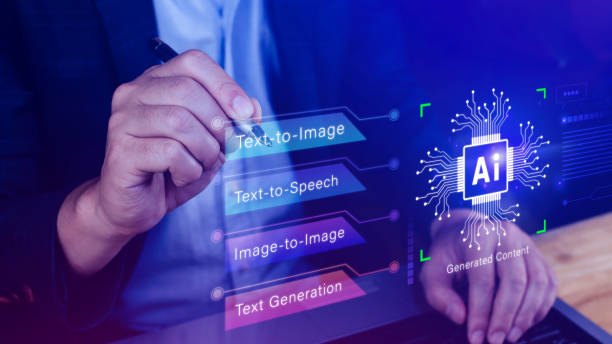
The development and use of AI robots raises important legal and ethical issues that must be addressed.
1.
Accountability: If an AI robot causes harm, who will be responsible? Is the responsibility borne by the robot’s manufacturer, the robot’s owner, or the robot itself? Determining accountability for AI robots is a complex legal challenge.
2.
Privacy: AI robots can collect a lot of data about users.
How can users’ privacy be protected from misuse of this data? Privacy laws and regulations must keep pace with the development of AI robots.
3.
Discrimination: AI robots can discriminate based on the data they are trained with.
How can discrimination be prevented in AI robots? Efforts should be made to ensure that AI robot training data is diverse and unbiased.
4.
Autonomous Weapons: The development of autonomous weapons controlled by artificial intelligence is a serious ethical concern.
Should robots be allowed to make decisions to kill without human intervention? Strict laws and regulations should be put in place regarding the development and use of autonomous weapons.
AI robots should not be used to harm humans.
Click here to preview your posts with PRO themes ››
5.
Transparency: The decisions of AI robots should be transparent and explainable.
Users should be able to understand why an AI robot made a particular decision.
Efforts should be made to make AI robot algorithms understandable and reliable.
In general, the development and use of AI robots requires attention to legal and ethical issues.
Efforts should be made to use this technology responsibly and for the benefit of society.
The proper use of AI robots can be very helpful.
Educational Resources to Learn More About Artificial Intelligence Robots

If you are interested in learning more about AI robots, there are several educational resources available.
These resources can include books, online courses, blogs, and articles.
1.
Online Courses: Online learning platforms like Coursera, edX, and Udacity offer several courses in the field of artificial intelligence and machine learning.
These courses can help you learn the basic concepts of artificial intelligence and develop your practical skills.
2.
Books: There are many books on artificial intelligence and machine learning.
Some of these books are suitable for beginners, while others are designed for more experienced individuals.
Choosing the right book depends on your level of knowledge and interest.
3.
Blogs and Articles: There are many blogs and articles on artificial intelligence and machine learning.
These resources can help you stay informed of the latest developments in the field and gain new perspectives.
AI robots are currently receiving a lot of attention.
4.
Online Communities: There are many online communities for those interested in artificial intelligence and machine learning.
These communities can help you connect with others, ask questions, and share your experiences.
5.
Practical Projects: The best way to learn artificial intelligence and machine learning is to do practical projects.
By doing practical projects, you can better understand the concepts and develop your practical skills.
AI robots can help you in doing these projects.
By using these educational resources, you can increase your knowledge and skills in the field of AI robots and become an expert in this field.
AI robots will play a more important role in the future.
Frequently Asked Questions
| Question | Answer |
|---|---|
| What is an AI robot? | It is a robot that uses artificial intelligence capabilities to understand the environment, reason, learn, and make decisions to perform complex tasks independently. |
| What is the main difference between a regular robot and an AI robot? | AI robots can learn and adapt to their environment, while regular robots usually operate based on fixed and pre-determined plans. |
| In what areas are AI robots used? | In areas such as industry (production lines), medicine (robotic surgery), services (customer support, smart vacuum cleaners), exploration (space and underwater), and entertainment. |
| How do AI robots learn? | They acquire new skills through machine learning and deep learning algorithms, by analyzing large data and identifying patterns. |
| Can AI robots have emotions? | Currently, no. They can identify or simulate emotions, but they do not have a real experience of emotions like humans. |
| What are the most important advantages of using AI robots? | Increasing productivity, reducing human error, performing dangerous or repetitive tasks, and providing new and efficient services. |
| What are some challenges in developing AI robots? | The need for large and high-quality data, the complexity of algorithms, ethical issues, cyber security, and the high cost of research and development. |
| Are AI robots dangerous to humans? | No, if safety design principles and ethical regulations are followed. Concerns are more related to social and economic impacts such as changes in the labor market. |
| What is an example of an AI robot in everyday life? | Smart vacuum cleaning robots (such as Roomba) that automatically map and clean the house, or smart voice assistants (such as Siri and Alexa). |
| How is the future of AI robots predicted? | They are expected to become smarter, more autonomous, and capable of more complex interaction with humans, and play a more prominent role in industry, medicine, transportation, and everyday life. |
And other services of Rasa Web Advertising Agency in the field of advertising
Smart Digital Advertising: An effective tool for digital branding by customizing the user experience.
Smart Link Building: A professional solution to increase sales by focusing on accurate audience targeting.
Smart Digital Advertising: A new service to increase website traffic by accurately targeting the audience.
Smart Google Ads: A new service to increase campaign management by accurately targeting the audience.
Smart Conversion Rate Optimization: A creative platform to improve sales by intelligent data analysis.
And more than hundreds of other services in the field of internet advertising, advertising consulting and organizational solutions
Internet Advertising | Advertising Strategy | Advertorials
Sources
Chatbot and why should we use a chatbot for our website?
,Artificial intelligence robot
,Comprehensive and practical chatbot guide
,Applications of artificial intelligence robots
? Are you looking to grow and be seen by your business in the digital world? Rasaweb Digital Marketing Agency, relying on up-to-date knowledge and extensive experience in the field of user-friendly website design and implementing effective online marketing strategies, is always ready to help you achieve great success.
📍 Tehran, Mirdamad Street, next to the Central Bank, Southern Kazerun Alley, Ramin Alley No. 6